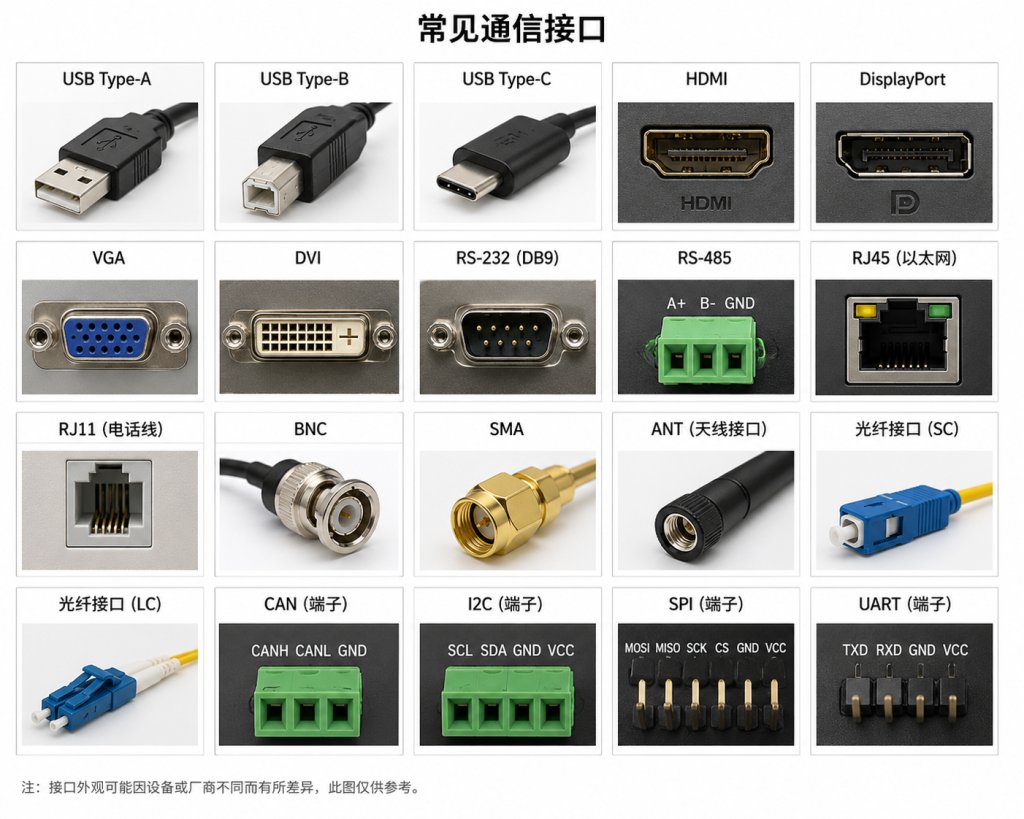



In a factory, weighing instruments, controllers, and PLCs not only need to perform their individual tasks but also need to exchange data. How do they "chat" with each other? They rely on communication interfaces.
Different interfaces have different strengths. Just like some people prefer making phone calls while others prefer sending WeChat messages, each has its own use.
RS485: A Veteran Powerhouse
RS485 is one of the longest-used interfaces in industry, and it hasn't been phased out after decades. What are its capabilities?
First, it can transmit over long distances. RS485 can transmit over a thousand meters, which is no problem for transmission between the two ends of the workshop. If a regular serial port is used, it will stop transmitting after a few dozen meters.
Secondly, it can connect multiple devices. Dozens of instruments can be connected to a single bus, all sharing the same line and taking turns communicating. The host computer asks a question, and that instrument answers.
Thirdly, it has strong anti-interference capabilities. RS485 uses differential signal transmission, where the voltage difference between the two lines determines whether the signal is 0 or 1. When external electromagnetic interference acts on both lines simultaneously, the fluctuation of the difference is small, resulting in strong anti-interference ability.
In a weighing system, multiple transmitters can transmit weight data to a computer via RS485, with Modbus RTU being the most commonly used protocol. For example, the SM40-HX batching controller from Zhongke Huigan supports both RS485 interface and Modbus protocol, allowing direct communication with a PLC or touchscreen.
Ethernet: The Speed Champion
If RS485 is a national highway, then Ethernet is a superhighway. Its transmission rate is hundreds or even thousands of times faster than RS485.
Ethernet offers clear advantages: high speed, the ability to transmit large amounts of data, and direct access to the factory's network system. A single computer can monitor all the weighing equipment in the workshop simultaneously via a network cable, displaying real-time weight data for each production line.
It also has disadvantages: the transmission distance is short (around 100 meters, beyond which a switch is needed), and the network configuration is slightly more complex.
For applications requiring large-scale data exchange and real-time monitoring, Ethernet is currently the mainstream choice. Zhongke Huigan's SMTX-CE100 industrial Ethernet gateway can convert CAN bus data into Ethernet signals, facilitating connection to upper-level systems.
CAN: A Master of Reliability
The CAN bus originated in the automotive industry. A car contains dozens of electronic modules: engine control, anti-lock braking, windows, airbags… These modules need to communicate reliably, and the failure of one module should not affect the entire system.
Two characteristics of CAN:
First, there's priority arbitration. When multiple devices send data simultaneously, those with higher priority send first, while those with lower priority automatically wait, preventing collisions and conflicts. This is extremely useful in PLC control, where critical instructions always have priority.
Secondly, it has strong fault tolerance. The CAN controller automatically detects errors and requests retransmission if data corruption is detected. Node failure will not paralyze the entire bus.
In batching systems, if multiple scales need to work together, the CAN bus ensures timely and reliable data transmission. Zhongke Huigan's SM40-I/OF industrial controller uses CAN bus communication for applications such as mixing plants that require multi-module联动 (interconnection/coordination).
Wireless communication: Get rid of cables
Wi-Fi, Bluetooth, ZigBee, and LoRa are all wireless interfaces. Their common advantage is that they eliminate the need for wiring.
In some scenarios, running cables can be cumbersome. For example, with a mobile weighing cart, a cable moves with the cart and is prone to wear and tear. Using a wireless cable is much more convenient.
LoRa is characterized by its long transmission range and low power consumption. Data can be transmitted back over distances of hundreds or even thousands of meters within a factory area using a single module, making it suitable for widely distributed monitoring points. ZigBee is suitable for building dense sensor networks, while Bluetooth is suitable for short-range connections to mobile apps.
The disadvantage of wireless is that it is susceptible to interference; the signal may be affected when a high-power motor starts. Its stability is also slightly lower than wired.
Communication protocol: the common language of devices
Having a physical interface alone is not enough; devices also need to speak the same language, which is called a communication protocol.
Modbus RTU is the most common. It's simple, open, and supported by most devices. The host computer sends a command: "Read the weight of the meter at address 1 to me," the meter receives the command, and returns the weight value. It's a simple question-and-answer process, easy to understand.
Profibus is widely used in Siemens PLCs. Profibus-DP is suitable for high-speed transmission of switching signals, while Profibus-PA is suitable for connecting sensors.
The CAN protocol defines the data link layer, while the application layer can use higher-level protocols such as CANopen to facilitate interoperability between devices from different manufacturers.
Simply put: the interface is the "road," and the protocol is the "traffic rules." Once the road is built, everyone still needs to follow the same rules to avoid collisions.
How to choose?
The choice of which interface to use depends on the actual requirements:
Simply transmit a few weight data points; for long distances and multiple devices → RS485
Requires large data volumes, real-time monitoring, and connection to the factory network → Ethernet
Multiple devices requiring coordinated control and high reliability → CAN
Equipment needs to be moved, wiring is difficult → Wireless
Many instruments support multiple interfaces simultaneously. For example, the SM40-HAX filling scale controller from Zhongke Huigan provides RS485, RS232, and CANBUS interfaces, allowing users to choose flexibly according to their site requirements.
Summarize
Communication interfaces are the "language system" of industrial equipment. RS485 is durable and reliable, Ethernet offers high speed and large capacity, CAN is stable and fault-tolerant, and wireless is flexible and convenient. There is no single best option; the right one is the one best suited to the specific on-site conditions. When selecting equipment, pay attention to which interfaces and protocols it supports, as this will affect whether the system can connect smoothly in the future.