



A bearing housing sensor (also known as a bearing housing load cell or bearing housing weighing sensor) is a specialized sensor that integrates force measurement with the bearing housing support structure. It is directly mounted below the bearing housing, replacing or embedding itself into the existing support structure. While providing support for the bearing housing, it simultaneously measures the load acting on the bearing in real time.Bearing housing sensors embody the application of force measurement in industrial applications.Modularization and integrationIts development direction is to be widely used in tension testing and overload protection systems in industries such as lifting, water conservancy, and metallurgy.
I. Structural Design
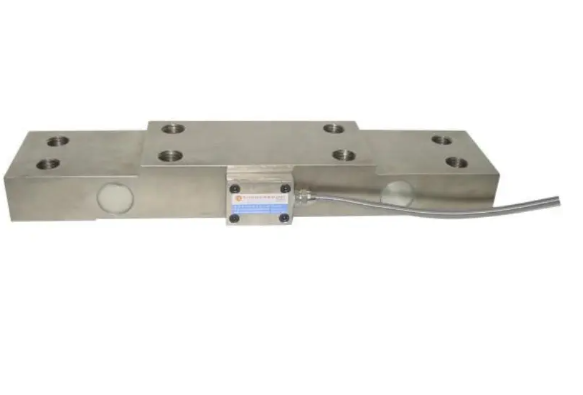
The core elastic element of the bearing housing sensor is aFlat or block-shaped metal substrateIts typical structure is as follows:Flat plate double shear beamDesign – The exterior is shaped like a flat plate, and the interior is specially processed to form a double shear beam elastic structure.This structure enables the sensor to haveLow profile and large contact areaIts characteristics enable high-precision measurement within a limited space..
In terms of structural layout, bearing housing sensors typically adopt...Fixed at both ends, bearing at the centerwayThe sensor is fixed to the base at both ends, and the middle part is used to install the bearing housing.When the bearing housing is under load, the load is transferred to the base through the shear elastic beams at both ends.Sensor selectionHigh-quality alloy steelAs an elastomer materialSome models can also be made of stainless steel to meet corrosion resistance requirements.Regarding sensitive elements, the following is adopted:foil resistance strain gaugeAs a sensitive element for force-to-electricity conversion.
The wiring method for bearing housing sensors is typically as follows:Lateral exitThis facilitates wiring in compact spaces. Depending on the installation space and measurement range, the sensor is available in several sizes, covering a range from 1.5 tons to 50 tons or even higher..
II. Working Principle
The working principle of the bearing housing sensor is based onResistance strain effectThe core process is as follows:
When an external force is transmitted to the bearing housing through the bearing, the bearing housing transmits the force to the sensor elastic body below.When an elastomer is subjected to force, it undergoes a small elastic deformation. A foil strain gauge, attached to a specific location on the surface of the elastomer, subsequently experiences strain, and its resistance value changes accordingly.The change in resistance is achieved through...Wheatstone bridgeThis is converted into a measurable voltage signal output. The millivolt-level output signal is then amplified and processed by subsequent instruments to obtain an electrical signal proportional to the load magnitude..
From a mechanical model perspective, the bearing housing sensor can be simplified to...Shear beam structure with fixed ends and concentrated load in the middleThis structure allows the shear stress to concentrate in a specific area of the elastic beam when the sensor is subjected to force. The strain gauges are precisely attached to these locations where the stress is greatest and the strain is most concentrated, thus achieving the highest sensitivity and optimal linearity..
Some high-end bearing housing sensors also useDouble shear beamStructural designThe double shear beam structure, by creating two symmetrical shear stress zones on the elastic body, not only improves the measurement accuracy of the sensor but also enhances its resistance to lateral forces and impacts.This structure allows the sensor to maintain a stable output even when subjected to off-center or impact loads.
III. Main Features
1. Compact structure and easy installation
The bearing housing sensor has a low-profile, flat design, allowing it to be directly installed beneath the bearing housing. It replaces the original bearing housing support structure while also performing force measurement, greatly simplifying the mechanical components of the entire force measurement system.No major structural modifications to the equipment are required during installation, greatly simplifying the on-site installation process..
2. Excellent resistance to lateral forces and impacts.
The flat, planar shape ensures stability under stress and minimizes lateral interference. The double shear beam structure provides the sensor with excellent resistance to lateral forces and impacts.Even under complex operating conditions such as off-center loading, vibration, or shock, the sensor can still maintain high measurement accuracy..
3. High precision and large range
Bearing housing sensor hasHigh measurement accuracyThe overall accuracy can reach 0.05%FSWith a wide measuring range, from 1.5 tons to 50 tons or even higher, it can meet the measurement needs of various equipment, from small cranes to large hydraulic gate hoists..
4. High protection level and strong environmental adaptability
Sensors typically reachIP66Protection level and aboveSome models can reachIP67 or even IP68Operating temperature range is wide, from -40℃ to +85℃.It can adapt to harsh industrial environments such as outdoor, dusty, and humid conditions.
5. Strong overload capacity
The bearing housing sensor has excellent safe overload capacity, typically 150%FS.Some models have a plastic deformation limit that can reach300%FSThe fracture limit can reach500%FSThis characteristic is particularly important for lifting equipment that is subjected to impact loads.
6. Optional built-in transmitter
Some models offer the option of a built-in transmitter for direct output.0~10mA, 4~20mA or 0~5VStandard industrial signals are used to facilitate direct interface with industrial control systems such as PLCs and DCSs.
IV. Main Application Areas
Bearing housing sensors are widely used in various industrial equipment that require bearing housing load monitoring and overload protection.
1. Lifting equipment
This is the core application area of bearing housing sensors. It is specifically designed for...Bridge cranes, gantry cranes, tower cranesDesign of lifting equipment for engineering projectsThe sensor is installed below the bearing housing of the crane hoisting mechanism drum to monitor the load borne by the drum bearing in real time.When the lifting weight exceeds a set threshold, the system can automatically issue an alarm or cut off the lifting circuit, thus achieving...Overload protectionIn addition, bearing housing sensors can also be used forCrane electronic scaleThis enables online weighing and measurement of hoisted goods.
2. Water conservancy projects
In the water conservancy industry, bearing housing sensors are widely used.gate hoistLoad monitoring of drum bearing housings in lifting equipment (sluice gates, dams)By measuring the stress on the gate hoist drum bearings in real time, the safe and reliable operation of the gate is ensured..also,Screw gate hoistBearing housing sensors are also commonly used for load protection.
3. Metallurgical and rolling mill equipment
In the metallurgical industry, bearing housing sensors can be used...Online detection of rolling mill bearing housing clearanceBy acquiring force changes through sensors, the system reflects the real-time gap information between the rolling mill bearing housing and the archway, providing data support for equipment maintenance. It can also be used for weighing and measurement on metallurgical crane electronic scales.
4. Conveying and Weighing System
Bearing housing sensors are widely used inConveyor belt weighingThe system achieves online material metering by real-time measurement of the load beneath the conveyor belt support bearing housing. It can also be used for...Automated equipmentForce value monitoring and process control.
5. Other industrial sectors
Bearing housing sensors are also used inport terminalsOverload protection of lifting equipmentMining vehiclesThe lifting system tension monitoring,Rail transitApplications include bearing load testing of equipment. Some specially designed bearing housing sensors can also be used in applications requiring...Wireless monitoringApplication scenarios.
V. Key Points for Selection
The following factors need to be considered when selecting a suitable bearing housing sensor:
- Range and loadSelect the appropriate range based on the actual maximum working load. Typical ranges range from 1.5 tons to 50 tons.It is recommended that the commonly used load be below the 70% range, leaving sufficient safety margin..
- Installation dimensionsIt must match the installation space, bolt hole spacing, and other dimensions of the equipment bearing housing.Sensors with different measurement ranges have significantly different external dimensions, so careful verification is necessary when selecting a model..
- Accuracy levelSelect a sensor with appropriate accuracy based on the required measurement precision; the overall accuracy can range from ±0.1%FS to 0.05%FS..
- Protection levelSelect IP66, IP67 or higher protection rating according to the usage environment.For outdoor or damp environments, it is recommended to choose products with a high level of protection..
- MaterialAlloy steel is an option for general environments.For humid or corrosive environments, stainless steel is recommended..
- Output signalFor long-distance transmission or direct connection with PLC, it is recommended to choose a model with a built-in transmitter and output of a 4~20mA standard signal.
- Operating temperatureSelect the appropriate operating temperature range based on the ambient temperature..
VI. Installation and Maintenance
Installation PrecautionsBearing housing sensors are typically installed below the bearing housing, with both ends fixed to the base and the middle supporting the bearing housing.During installation, ensure the sensor is aligned with the direction of force to avoid off-center loading affecting measurement accuracy. The sensor is typically fixed to the bearing housing and base with bolts; tighten the bolts to the specified torque during installation. The sensor should be installed on...rigid structureTo ensure effective capture of load information, it is recommended to perform no-load and load tests after installation to verify that the sensor output is normal.
Maintenance and CalibrationIt is recommended to regularly check that the sensor's mounting bolts and connectors are tight. Regularly check the cables for damage or poor contact. It is recommended to perform on-site calibration or return the sensor to the manufacturer for calibration annually; for high-frequency applications, the calibration cycle can be appropriately shortened. Keep the sensor clean and avoid corrosion from oil, dust, water, and other contaminants.
VII. Development Trends
As an important product in the field of industrial force measurement, the future development trend of bearing housing sensors mainly focuses on the following aspects:
FirstIntelligentBearing housing sensors integrating intelligent algorithms can achieve data processing and decision support, such as predicting equipment failures and realizing condition monitoring and fault diagnosis through AI algorithms. Secondly...WirelessWireless transmission technology makes the application of sensors more flexible in complex working conditions. Thirdly...High sensitivity and self-poweredNovel piezoelectric stack segmented arrangement and other technologies enable sensors to have higher sensitivity, and even achieve…Self-poweredIntelligent monitoring. Fourthly...Easy maintenanceThe quick-release mounting structure makes sensor disassembly and maintenance much easier.
With the deepening of Industry 4.0 and the Internet of Things, the demand for high-precision, high-reliability, and intelligent bearing housing sensors will continue to grow. Technological innovation and application expansion in this field deserve continued attention.