



A load pin sensor (also known as a load pin sensor, load pin type sensor, or stress pin) is an integrated sensor that combines weighing and force measurement functions with a mechanical pin structure.It originated from the trend of electronic weighing instrument integration in the 1990s—combining the load cell and the load sensor into one unit, making the sensor itself an integral load cell.Axle pin sensors can directly replace ordinary pins in mechanical equipment, performing mechanical connection and load-bearing functions while simultaneously measuring the load acting on them in real time..
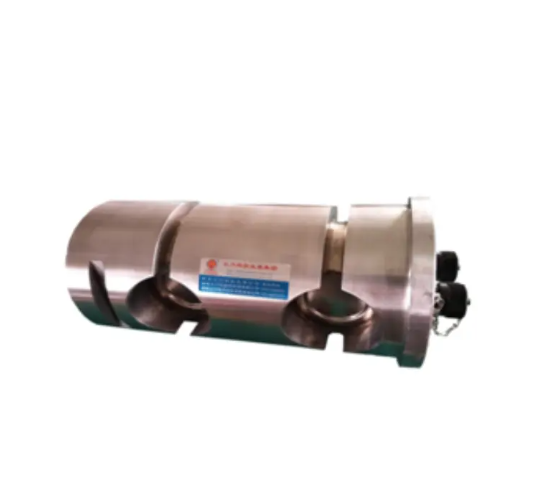
I. Structural Design
The core elastic element of the pivot pin sensor is a single...Hollow cross-section circular shaft subjected to shear forceUnlike traditional solid pins, it has a central hole with grooves at specific locations on the inner wall of the hole.Double shear resistance strain gaugeThat is, to stick it in the center of these grooves.
Structurally, the elastic element of the shaft pin sensor is a single hollow circular shaft, with a simple geometry and compact structure.This design enables it to be manufactured with very high dimensional and geometrical accuracy.The sensor has two wiring options: radial and axial, which can be flexibly selected according to the installation space.
Based on their structural form, pin sensors can be divided into:Blind hole typeandThrough-hole typeThere are two main categories. Blind via products are easy to machine and surface mount package, have high precision and stable performance, but their safe overload performance is greatly affected by the loading direction.
II. Working Principle
The working principle of the shaft pin sensor is based onResistance strain effectWhen an external force is transmitted to the elastic body through the shaft pin, the hollow circular shaft undergoes elastic deformation. The strain gauge attached to the groove inside the central hole then experiences strain, causing a change in its resistance value.The change in resistance is achieved through...Wheatstone bridgeConverted into a measurable electrical signal output.
Regarding the bridge configuration, the pin-type sensor offers two options: one is to have two double-shear resistance strain gauges at the two grooves form a Wheatstone bridge; the other is to form separate Wheatstone bridges and then connect them in parallel for measurement.Both methods have their own characteristics, and the choice can be made based on specific accuracy requirements and application scenarios.
From a mechanical model perspective, the shaft pin sensor can be simplified to...Hollow section beam simply supported at both ends and subjected to concentrated load in the middleThe sensor's output is affected by a variety of factors, primarily including the diameter of the central hole, the minimum diameter of the groove, the clearance between the pin and the support, the support stiffness, and the strain gauge size.Therefore, these factors must be comprehensively considered during structural design to achieve optimal size selection..
III. Main Features
1. Compact structure and easy installation
The shape of the pin sensor is exactly the same as that of a regular pin, and it can directly replace the original mechanical pin, usually without the need for structural modifications to the equipment.It can both replace the original shaft and act as a weighing and force sensor, greatly simplifying the mechanical components of the entire force measurement and control system.
2. Excellent mechanical properties
Hollow cross-section circular shafts have strong resistance to torsion and bending, and the shaft pins...The stress is greatest at the neutral axis.When a hollow section shaft pin is subjected to both vertical and horizontal bending, the section with zero bending moment occurs on the same section.This characteristic enables the sensor to maintain stable measurement performance under complex stress environments.
3. High protection level
When designing large-capacity shaft pin sensors, the center hole is correspondingly larger, allowing the strain gauge to be properly protected by being mounted inside the hole.Simultaneously, a vacuum-sealing process with inert gas filling can be implemented to achieve a higher protection level for the sensor (such as IP67 or even IP69K)..
4. High precision and customization
The pin sensor features high precision and low drift.Some models can be equipped with a built-in transmitter to directly output standard industrial signals such as 0-10mA, 4-20mA, or 0-5V.The sensor can also be customized in different sizes and measuring ranges according to user requirements.Typical capacity range covers 0.5 tons to 100 tons.
The main disadvantage of the pivot pin sensor isThe production process is quite difficult.Since the strain gauges need to be mounted inside deep holes, it is necessary to purchase and design specialized tools and equipment for sandblasting, marking and mounting, and pressure curing..
IV. Main Application Areas
Axis pin sensors are widely used in various mechanical equipment that require force measurement and overload protection.
1. Lifting and hoisting equipment
This is the most typical application area for axle pin sensors. They can be installed in the hinge holes of crane boom pulleys, moving pulley blocks, fixed pulley blocks, etc., to monitor wire rope pressure and lifting load in real time. Many tower cranes, gantry cranes, and heavy port equipment use axle pin sensors for overload alarms and safety protection.In addition, pivot pin sensors are also widely used in the hydraulic systems of lifting equipment such as cable cars, stage construction equipment, and hoisting systems.
2. Electronic crane scales and overhead crane scales
The pin sensor, in conjunction with the U-shaped lifting ring, can be assembled into a digital display or wireless transmission electronic crane scale.Because the axle pin is directly assembled with the lifting ring and hook, it not only eliminates the need for a complex load-bearing shell, but also improves assembly precision and ensures weighing accuracy..
3. Rigging and tension monitoring
The pin sensor can be easily installed in the shaft hole of components such as hooks, rigging shackles, wedge joints, cable knots, marine rigging, open spiral buckles, tie rod heads and fork joints, connecting forks, lifting rings, and steel wheels. It is a specialized sensor for measuring the radial load of components such as bearings and pulleys, or the tension of wire ropes.
4. Construction Machinery and Vehicles
In construction machinery such as excavators and loaders, axle pin sensors can be used to measure the force on the pin between the bucket and the stick. In the automotive industry, it can be used for applications such as fifth-wheel force measurement.Furthermore, overload protection and tension monitoring in scenarios such as mining vehicles and hoisting systems also rely heavily on axle pin sensors..
5. Other industrial sectors
Axle pin sensors are also used in port and dock metering, automobile pressing, automated assembly, agricultural machinery seeding pressure measurement, hydraulic engineering screw-type gate hoist load protection, rail transportation, aerospace, building structure testing and other fields.Thin-film based pin sensors can even be used in hazardous areas such as mining.
Axis pin sensors can be used forStatic force measurementIt can also be usedDynamic force measurementSome high-end products employ metal thin-film technology, enabling them to measure tensile and compressive forces under harsh operating conditions.
V. Key Points for Selection
The following factors need to be considered when selecting a suitable pivot sensor:
- Shaft diameter and dimensionsIt must match the diameter, length, thread, and other parameters of the existing pins in the equipment.
- Force range and measurement rangeSelect the appropriate range based on the actual load size. It is recommended that commonly used loads be within the 70% range.
- Accuracy levelSelect the appropriate accuracy (e.g., 0.02, 0.05 grade, etc.) according to the measurement requirements.
- Protection levelChoose IP65, IP67 or higher rating depending on the usage environment.
- Explosion-proof requirementsIf used in hazardous areas, an explosion-proof model must be selected.
- MaterialFor humid or corrosive environments, stainless steel is recommended.
- Output signalFor long-distance transmission, it is recommended to select a device with a built-in transmitter that outputs a standard 4~20mA signal.
VI. Installation and Maintenance
Installation PrecautionsDuring installation, ensure the sensor is aligned with the direction of force to avoid lateral forces or bending moments affecting measurement accuracy.Directly striking the sensor body is strictly prohibited. If striking is necessary during installation, a copper rod or cork should be used as a pad.The sensor strength is no less than that of the original mechanical pin.After installation, it is recommended to perform no-load and load tests.It is particularly important to note that the sensor should be removed when the equipment is used for electric welding to avoid damage to the internal circuitry from high current.
Maintenance and CalibrationIt is recommended to perform on-site calibration or return the device to the manufacturer for calibration annually.For high-frequency applications, the calibration cycle can be appropriately shortened.Regularly check the sensor installation to ensure it is securely fixed and free from looseness or damage. Keep the sensor clean and avoid contact with oil, dust, water, and other chemicals.
VII. Development Trends
Axis pin sensors embody the characteristics of electronic scales.Miniaturization, modularization, integration, and intelligenceDevelopment directionFuture development trends will mainly focus on the following aspects: Firstly...IntelligentSensors integrating intelligent algorithms can achieve data processing and decision support, such as predicting equipment failures through AI algorithms; secondly,WirelessWireless transmission technology makes the application of sensors more flexible in complex working conditions; thirdly...Energy self-sufficiencyEnergy harvesting technology will reduce dependence on external power sources.
With the advancement of industrial automation and the Internet of Things, the demand for high-precision, high-sensitivity, and highly interference-resistant pin sensors will continue to grow. Technological innovation and application expansion in this field deserve continued attention.