


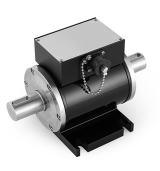
Torque Sensor / HG504D Dynamic Torque Sensor
Product Categories Torque Sensors
The dynamic torque sensor is a precision measuring instrument developed based on proprietary strain gauge bridge technology. It is specifically designed to measure various torques, speeds, and mechanical power on various rotating or non-rotating mechanical components. This series of torque sensors employs strain gauge bridge electrical measurement technology, using a set of toroidal transformers for non-contact power supply. A low-power signal coupler replaces the toroidal transformer for non-contact signal transmission, effectively overcoming the high-order harmonic self-interference caused by inductive coupling and the mutual interference between the power toroidal transformer and the signal toroidal transformer. Furthermore, the output spike pulse is converted into a square wave signal. Therefore, this series of torque sensors can operate at high speeds for extended periods.
This series of torque sensors can measure both torque and speed simultaneously, and can be used for both static and dynamic measurements. The various installation options offer users great convenience.
I. Product Overview:
The dynamic torque sensor is a precision measuring instrument developed based on proprietary strain gauge bridge technology. It is specifically designed to measure various torques, speeds, and mechanical power on various rotating or non-rotating mechanical components. This series of torque sensors employs strain gauge bridge electrical measurement technology, using a set of toroidal transformers for non-contact power supply. A low-power signal coupler replaces the toroidal transformer for non-contact signal transmission, effectively overcoming the high-order harmonic self-interference caused by inductive coupling and the mutual interference between the power toroidal transformer and the signal toroidal transformer. Furthermore, the output spike pulse is converted into a square wave signal. Therefore, this series of torque sensors can operate at high speeds for extended periods.
This series of torque sensors can measure both torque and speed simultaneously, and can be used for both static and dynamic measurements. The various installation options offer users great convenience.
II. Technical Specifications:
| Indicator Name | Parameters and Specifications |
| range | 3 N.M, 10 N.M, 50 N.M, 100 N.M, 500 N.M, 1000 N.M, 2000 N.M, 5000 N.M, 10000 N.M, 20000 N.M, 50000 N.M. Other ranges are available upon request. |
| Power supply | 24VDC |
| Torque signal | 5~15kHz (amplitude 24V, zero point 10kHz), optional instruments, current signal: 4~20mA12mA±8mAVoltage signal: 0±5V, 0±10V or communication R485, etc. |
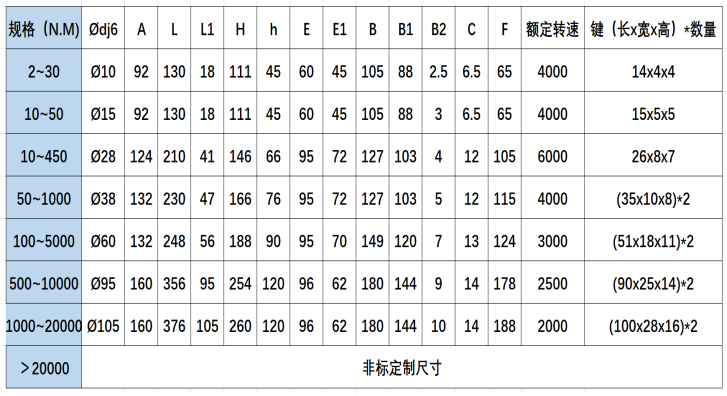
| Speed range | Different models have different rotational speeds; please refer to the parameters in the corresponding model's dimension drawing. |
| Speed signal | 60 pulses/revolution, 30 pulses/revolution(No accumulated error, amplitude 24VDC)It can be used with our company's power meters; current signal: 4~20.mAVoltage signals: 1-5V, 0-10V, 0-5V, or R485, etc. |
| Accuracy | Default: ±0.3% |
| Insulation resistance | ≥200MΩ (100VDC) |
| Ambient temperature | -10~60℃ |
| Relative humidity | 0~90%RH |
| Overload capacity | 120% |
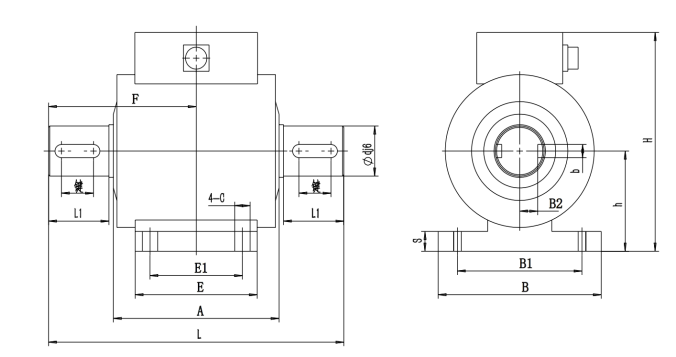
III. External Dimensions:
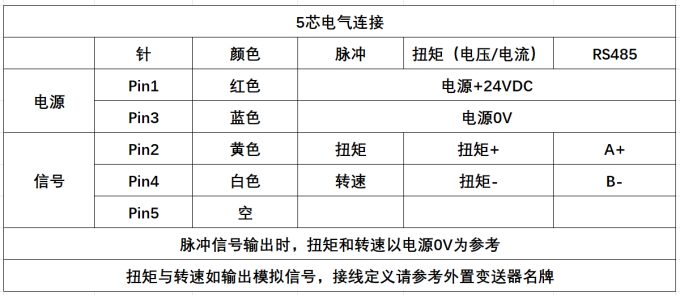
IV. Electrical Connections:
V. Product Features:
(1) It can measure both static torque and rotational torque;
(2) High detection accuracy, good stability, and strong anti-interference ability;
(3) Small size, light weight, and easy to install;
(4) The forward and reverse torque can be continuously measured without repeated zeroing;
(5) It adopts a non-contact principle and has no wear parts such as slip rings, so it can run at high speed for a long time;
(6) Strong anti-interference ability, can be installed in any position and any direction (horizontal/vertical).
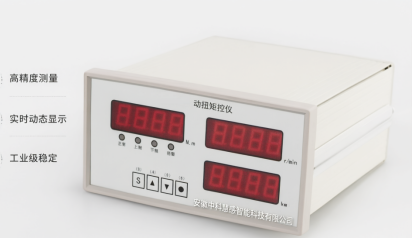
(7) The sensor part can be used independently without the secondary instrument and can be directly combined with the measuring board, PLC or DCS to form a torque measuring device.
VI. Application Areas
(1) Mainly used for testing the output torque and power of rotating power equipment such as electric motors, engines, and internal combustion engines;
(2) Test the load torque and input power of equipment such as motors, fans, pumps, mixers, reducers, gearboxes, gearboxes, winches, and propellers;
(3) Testing of torque and power in various railway locomotives, automobiles, tractors, airplanes, ships and mining machinery;
(4) Detect the torque during the working process of various machining centers and automatic machine tools;
(5) Detect the torque and efficiency transmitted by various rotating power equipment systems;
(6) It can be used for torque and power detection in sewage treatment systems;
(7) The torque can be detected at the same time as the rotational speed and shaft power;
(8) It can be used to manufacture viscometers, screw tightening devices, electric and pneumatic valves, and hydraulic torque wrenches;
(9) It can be used in process industries and process industries.
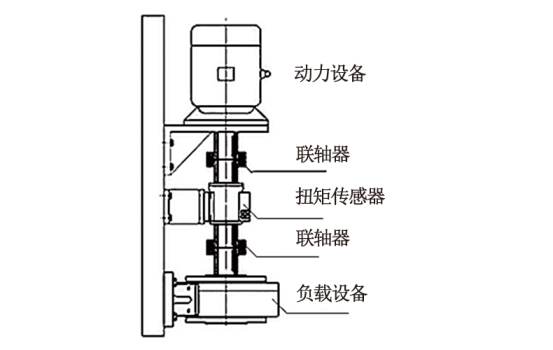
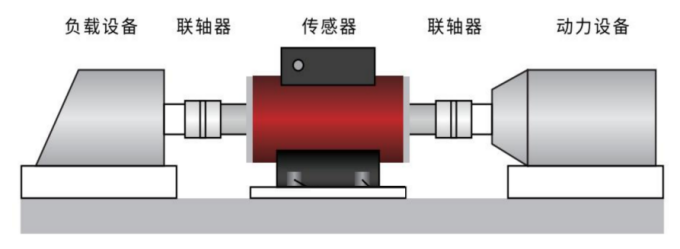
VII. Installation Diagram
(1) Horizontal installation diagram
(2) Vertical installation diagram