



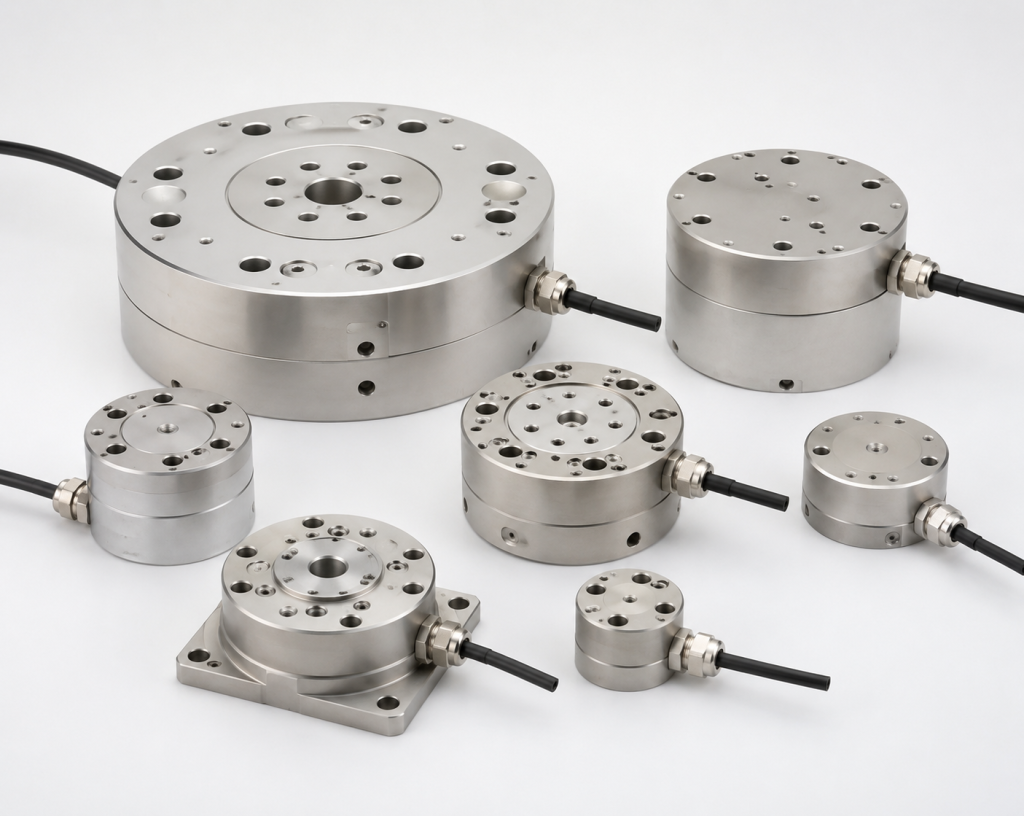
The six-dimensional force sensor is hailed as the leading force sensor in the field. "Top of the pyramid" productsIt can simultaneously measure all possible motions of an object in space, that is...Force components (Fx, Fy, Fz) in three directions and torque components (Mx, My, Mz) in three directions.Unlike traditional one-dimensional or three-dimensional force sensors, six-dimensional force sensors can not only sense pushing and pulling forces, but also accurately identify complex torque changes such as twisting and bending. They are the core sensing components for robots to achieve flexible and intelligent interaction with the outside world.
I. Working Principle and Core Technologies
The working principle of a six-dimensional force sensor is based onResistance strain effectBased on this foundation, its core can be summarized as follows: Synergistic effect of "elastic body + strain gauge":
elastomerIt is a sensor "skeleton" —When subjected to external force, the internally designed structure will produce micron-level elastic deformation in specific areas.strain gaugeThat is "Nerve endings" —A metal foil or semiconductor strain gauge attached to the surface of an elastomer changes its resistance with deformation. Multiple strain gauges are used.Wheatstone bridgeIt converts minute resistance changes into millivolt-level electrical signals.
The real technical challenge of six-dimensional force sensors lies inSignal decouplingWhen an external force is applied to the sensor, the output of each strain gauge is the result of the combined action of forces and moments in multiple directions. Precise calibration experiments are needed to establish...Sensitivity matrix(Also known as a coupling matrix), it "splits" the mixed signal into six independent dimensions of force and torque values. The accuracy of this decoupling algorithm directly determines the final performance of the sensor.
From the perspective of measurement principle, six-dimensional force sensors are mainly divided intostrain gauge type(Including metal foil and silicon strain)Capacitive,piezoelectric,PhotoelectricandFiber opticTypes such as... Among them...strain gauge typeIt is the most traditional and mature technical route, with the advantages of relatively simple structure and low cost.
II. Structure and Classification
In the design of elastomer structures, there are various implementation schemes for six-dimensional force sensors. Common structural forms include:
- cylindrical structureIts structure is relatively simple, and it is a typical solution for early wrist force sensors.
- cross-shaped structureWidely used in wrist force sensors
- Three-beam structureSignal separation is achieved through the rational design of strain gauge beams and bridge circuits.
- Z-shaped thin-walled beam structureUp to [number] pairs are arranged on the surfaces of the thin-walled beams on both sides.24 micro strain gaugesThis constitutes the Wheatstone full-bridge measurement circuit.
Depending on the installation location, a six-dimensional force sensor is often referred to as...Wrist force sensor(Installed at the robot's wrist joint). In recent years, with technological advancements, other technologies have also emerged...fingertip sizeThe ultra-small, flexible six-dimensional force sensor can be applied to delicate scenarios such as dexterous fingertip operation.
III. Main Application Areas
The application of six-dimensional force sensors has expanded from traditional industrial scenarios to a wider range of fields, mainly including:
1. Robotics – Core Driving Force
This is the most important and fastest-growing application area for six-dimensional force sensors. In humanoid robots, the sensors are mainly installed in...wrists and anklesAt joints, six-dimensional force sensors provide real-time dynamic mechanical feedback for the robot. Collaborative robots have been deployed on a large scale in precision assembly scenarios such as 3C electronics. In scenarios such as precision assembly, automated grinding, contour tracking, and ambidextrous coordination, six-dimensional force sensors are key to achieving high-precision force control. It can be said that six-dimensional force sensors are essential for robots... A crucial link in the leap from "automated machines" to "intelligent life forms"..
2. Medical and Health Field
In surgical robots, six-dimensional force sensors achieve force feedback.0.1mm levelIt enables delicate procedures such as vascular suturing. It provides tactile feedback in minimally invasive and laparoscopic surgeries, improving surgical safety. Rehabilitation equipment uses sensors to quantify joint stress data, allowing for customized training programs for patients.
3. Aerospace field
The six-dimensional force sensor is suitable for dynamic testing and attitude control in extreme environments, and is an important measurement tool for scenarios such as aircraft testing and space docking.
4. Industrial Automation
In applications such as automotive testing, product testing, and robotic grinding and polishing, six-dimensional force sensors help maintain stable positioning and highly repeatable trajectories. They are also used in scenarios such as monitoring tire performance.
IV. Key Points for Selection
When selecting a suitable six-dimensional force sensor, the following key factors should be considered:
- RangeIt is recommended to choose a value greater than the maximum possible value in actual application.Slightly largerThe measurement range is adjusted to prevent sensor damage from accidental collisions or overloads.
- Precision and resolutionPrecision assembly (such as in 3C manufacturing)0.01mm level(Interval insertion/removal) requires extremely high precision.
- CrosstalkKey indicators for measuring the degree of signal interference between different dimensions
- technical routeStrain gauge and optical solutions represent two mainstream and distinct technical approaches, and the choice between them profoundly impacts performance, cost, and application boundaries.
- Environmental adaptabilityThis includes temperature drift, protection rating, etc.
V. Development Trends and Challenges
Explosive market growthThe shipment volume of six-dimensional force sensors for humanoid robots in China is expected to reach [amount missing] by 2025.12,300 unitsa year-on-year surge510.1%Six-dimensional force sensors account for a significant portion of the value of robots.16%.
Domestic substitution acceleratesFor a long time, the domestic high-end six-dimensional force sensor market has been monopolized by overseas brands, with high barriers to entry in core technologies, calibration equipment, and mass production processes creating a "bottleneck" situation. In recent years, relying on accumulated aerospace force measurement technology, domestic companies have achieved breakthroughs in key technologies such as elastic body design and six-dimensional information decoupling algorithms, realizing high-performance sensors.100% Domestic ProductionLeading manufacturers have already exceeded [a certain percentage] of market share.70%.
Continuous technological innovationFrom traditional rigid and bulky structures toUltralight, small, flexibleFuture development directions include: New sensors can achieve six-dimensional force sensing by capturing the spatial strain field of elastic pressure-thermal materials. Intelligence, wireless connectivity, and high integration are important directions for future evolution.
Six-dimensional force sensors, as the ultimate solution for force perception, are moving from the laboratory to large-scale industrialization. They are not only for humanoid robots and embodied intelligence...Core sensing componentsFurthermore, it is an important benchmark for measuring a country's technological strength in the field of high-end sensors. With the advent of the mass production wave of embodied intelligent robots, six-dimensional force sensors are ushering in unprecedented development opportunities.