



Plate tension sensor, also commonly known asPlate ring type tension sensororPlate tensile force sensorIt is an important branch of the resistance strain gauge tension sensor family.Its core feature is the design of the stressed elastic body as...Plate-like or plate-ring structureWhile performing the function of mechanical connection, it accurately measures the tensile force acting along its length.
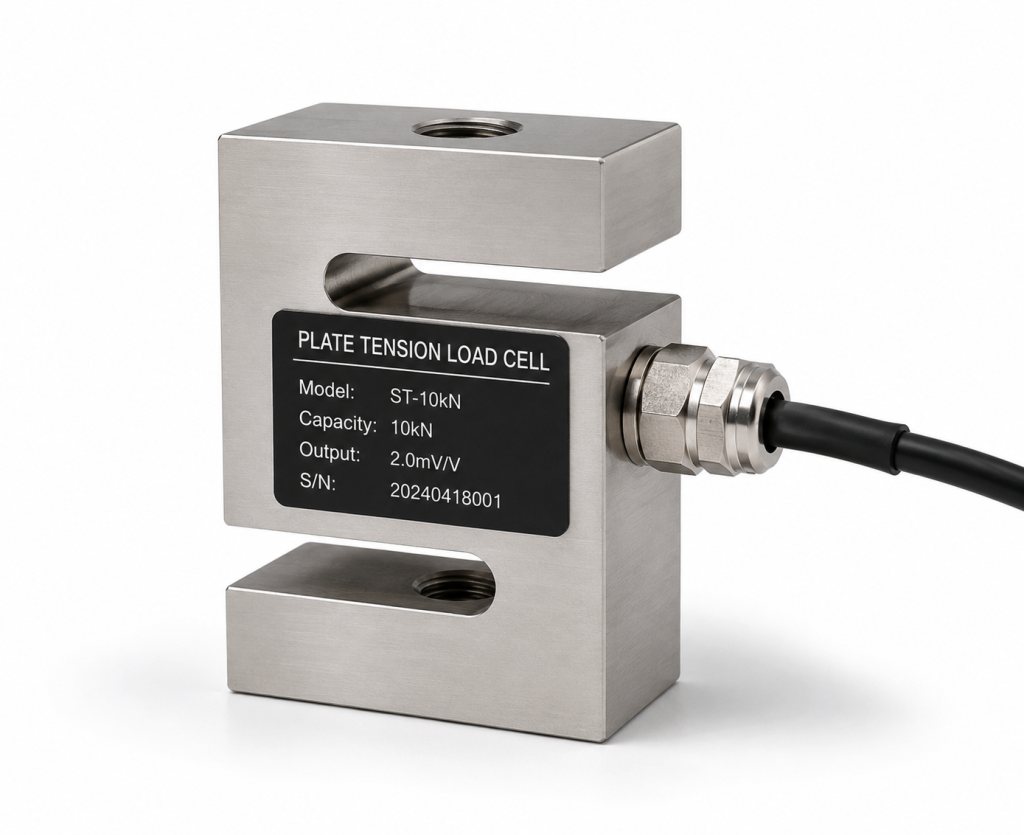
Its development stemmed from improvements to traditional tension sensors (such as S-shaped and blind-hole thin-walled types). These traditional sensors are often large in size, have poor resistance to off-center loads, or have limited overload capacity.The plate tension sensor utilizes a unique plate ring structure design to...Measuring range, accuracy, safety and environmental adaptabilityA better balance was found between them.
I. Structural Design
The core structure of the plate tension sensor is a precision-machined...Metal elastomersIts shape is usually plate-like or plate-ring-like.Its typical structure can be summarized as follows:Three-sectiondesign:
- Upper force transmission section: hasBearing pin holeIt is used to connect to a fixed structure above (such as a hanger or bracket) via a pin.
- Intermediate force transmission sectionThis is the core sensitive area of the sensor, which is equipped with...Tension sensing through holeOn the inner wall of the through hole, precisely adhered...Resistance strain gaugeTo ensure measurement accuracy, these strain gauges are typically arranged symmetrically along the width of the plate.To extract the weak electrical signal generated by the strain gauge, the middle section is also equipped with a connection to the sensing through-hole.Signal wiring hole.
- Lower power transmission section: hasBearing hole(Such as the hook hole of an electric hoist), used to connect the lifted heavy object or load-bearing component..
To ensure accurate and coaxial transmission of tensile force, the centerlines of these three key holes (pin hole, sensing hole, and hook hole) are typically designed to be on the same mid-plane along the length of the plate.This design minimizes measurement errors caused by force eccentricity.
In terms of materials, elastomers are usually selectedHigh-quality alloy steelorStainless steelIt undergoes surface treatments such as nickel plating to enhance its corrosion resistance and environmental adaptability.To cope with harsh working conditions such as humidity and dust, stepped holes are usually provided at both ends of the induction through-hole, and...Waterproof coverA sealing and bonding process is performed to protect the internal strain gauges and circuitry..
II. Working Principle
The working principle of the plate tension sensor follows the classic...Resistance strain effect.
Its workflow is as follows:
- Force and DeformationWhen a tensile force is applied along the sensor axis (i.e., the length direction of the plate), the plate ring structure, which is an elastic body, will undergo a small elastic deformation.
- resistance changeThe resistance strain gauges attached to the inner wall of the sensing through-hole will stretch or compress with the deformation of the elastic body, causing a corresponding change in their resistance value..
- Signal conversionStrain gauges are typically manufactured according to...Wheatstone bridgeConnect in this wayThe bridge circuit converts minute changes in resistance into a proportional differential voltage signal output..
- Signal processingThe output millivolt-level signal can be amplified, filtered, and processed by built-in or external transmitters to ultimately output a standard industrial signal, such as...4-20mA current,0-5V/0-10V voltageorRS485 digital signal.
III. Main Features
The reason why plate tension sensors occupy an important position in the field of industrial force measurement is mainly due to the following significant characteristics:
- Simple structure and wide measuring rangeIts plate-ring structure is relatively simple and easy to manufacture. At the same time, it can cover a very wide measurement range, from hundreds of kilograms to...Hundreds of tonsFor example, the typical product range can reach...2 tons to 100 tonseven higher.
- High measurement accuracyThanks to mature resistance strain gauge technology and precise elastomer design, plate tension sensors achieve high overall accuracy. The overall error (including nonlinearity, hysteresis, and repeatability) of typical products can be controlled within [specific range].±0.03%F.Sto±0.05%F.Sbetween.
- High safety and reliabilityPlate ring structures inherently possess good overload resistance.Safety overloadTypically achievable150%F.S(Full scale)Some designs can even withstand higher loads before fracture. Meanwhile, a well-designed seal allows it to achieve a protection level of up to [missing information].IP67Even higher, capable of adapting to harsh environments such as outdoors and damp conditions..
- Easy to install and useIts plate-like shape makes it easy to connect to wire ropes, tie rods, and other load-bearing lines via pins or other means, allowing for flexible and convenient installation. Simultaneously, it supports...Tension and compression dual-purposeThis further expands the scope of application.
IV. Main Application Areas
With its large range, high reliability, and good environmental adaptability, plate tension sensors are widely used in various industrial force measurement and weighing scenarios:
- Lifting and hoisting equipmentThis is one of its core application areas. It is often installed in...Tower cranes, bridge cranes, gantry cranesIn a tie plate or tie rod structure, asOverload limiterThe core sensing element monitors the lifting load in real time to prevent overload accidents.It is also widely usedHook scalemiddle.
- Industrial weighing systemIn various large-scale weighing equipment, plate ring type tension sensors play an important role, for example...Electronic truck scales, rail scales, platform scales, hopper scales.
- Ports and docksUsed for weighing and overload protection in various lifting and loading/unloading equipment at ports and docks..
- Other industrial force measurementIt is also widely used inWire rope tension monitoring,High-altitude electrical constructionTension control,Building materials and chemicalsHopper weighing industryas well asMining car weighingfields.
V. Key Points for Selection
When selecting a suitable plate tension sensor, the following key factors need to be considered:
- RangeSelect a sensor with an appropriate range based on the actual maximum tensile force measured. It is generally recommended that the commonly used load be within the sensor's rated capacity.70% Within this range, sufficient safety margin should be reserved.
- Accuracy levelSelect a product with the appropriate overall accuracy based on the application's requirements for measurement accuracy (such as 0.03%FS or 0.05%FS).
- Installation method and dimensionsConfirm whether the sensor mounting hole size, plate thickness, etc., match the existing mechanical structure.
- Output signalSelect based on the interface requirements of subsequent instruments or control systems (such as PLCs).mV/V,4-20mAorRS485Output signal type.
- Environmental adaptabilityChoose the appropriate material (alloy steel or stainless steel) and protection level based on the temperature, humidity, and corrosiveness of the environment.
- Brand and QualityPrioritize products from manufacturers with a good reputation and professional manufacturing experience..
VI. Installation and Maintenance
Proper installation and maintenance are key to ensuring the long-term stable operation of the sensor.
Installation Precautions:
- Ensure ChinaDuring installation, ensure that the line of action of the tension force passes through the central axis of the sensor to avoid lateral forces or bending moments, otherwise the measurement accuracy will be seriously affected.
- rigid baseThe sensor mounting base should have sufficient strength and rigidity, and its strength requirement is usually higher than that of the sensor itself.
- Clean surfaceBefore installation, ensure that the mounting and contact surfaces of the sensor are flat, clean, and free of oil or debris.
- Do not knockDo not strike the sensor body directly, as this may damage the internal strain gauge.
Maintenance Recommendations:
- Regular inspectionRegularly check whether the sensor connectors (such as pins and bolts) are loose and whether the cables are intact.
- Keep cleanKeep the sensor surface clean and avoid chemical corrosion.
- Regular calibrationIt is recommended to calibrate the sensor regularly (e.g., annually) based on usage frequency and environment to ensure measurement accuracy.
VII. Development Trends
With the deepening of industrial automation and intelligence, plate tension sensors are also constantly evolving:
- Intelligentization and DigitalizationIt integrates more signal processing functions, and even has built-in edge computing capabilities, directly outputting digital signals or performing preliminary data analysis..
- WirelessIntegrated wireless transmission module enables remote data monitoring, reduces wiring costs, and is suitable for mobile or difficult-to-wire scenarios..
- Modular and easy to maintainThe modular design allows for individual replacement of damaged parts, reducing maintenance costs and resource waste..
- New materials and new processesExplore the use of novel elastomer materials and more advanced manufacturing processes to further improve the accuracy, reliability, and environmental adaptability of sensors.
In summary, the plate tension sensor is characterized by its...Large range, high precision, simple structure and robust reliabilityIts unique properties have made it an indispensable tool in the field of modern industrial force measurement. From ensuring the safe operation of large lifting equipment to achieving accurate weighing in industrial processes, it plays a crucial role.