



As an indispensable vertical transportation tool in modern buildings, the safety, comfort, and operational efficiency of elevators are of paramount importance. In the intelligent evolution of elevators, sensors play the role of "nerve endings"—they sense the elevator's...Speed, position, load, gate status, temperature, vibrationThese key parameters convert physical quantities into electrical signals, providing a basis for decision-making in the control system.It can be said that it is these diverse sensors, each with its own specific function, that work together to safeguard the safety and smoothness of every lift and drop.
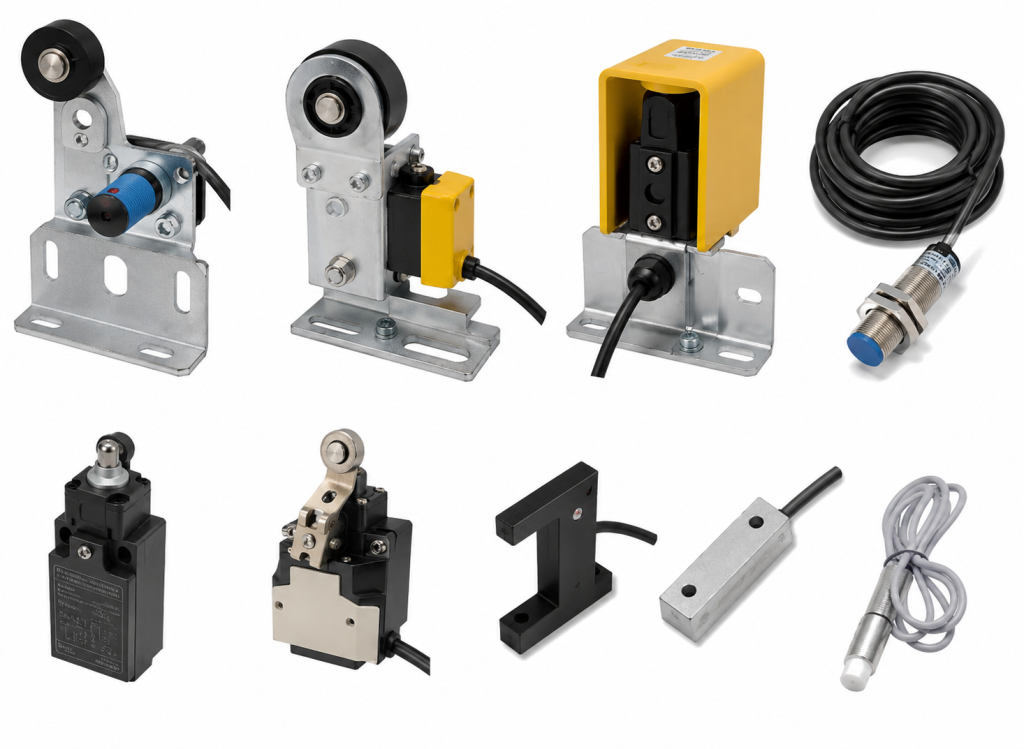
I. Classification and Functions of Elevator Sensors
There are many types of sensors used in elevators, which can be roughly divided into the following categories according to their functions:
1. Speed and position sensors
This is the most critical type of sensor in the elevator control system, responsible for real-time monitoring of the elevator's operating speed and the precise position of the car in the shaft.
- encoderInstalled on the elevator traction machine (motor) or guide rails, it is part of the elevator...High-precision position and velocity feedbackcore componentsIts working principle is based on photoelectric, magnetoelectric, or inductive technology, and its core components include a rotating encoder disk and a photoelectric sensor.When the motor rotates, the encoder disk rotates accordingly, and the sensor detects the encoded information and generates a pulse signal.The control system analyzes these signals to accurately calculate the elevator's position, speed, and direction of travel.The encoder serves multiple functions, including precise leveling control, smooth speed regulation, safety protection, and energy-saving operation..
- Leveling sensorUsed to detect whether the elevator car has accurately reached the target floor.It is typically installed on the side of the car and determines the car's position by detecting signals from floor sensors inside the hoistway.The leveling sensor works in conjunction with the encoder to ensure that the elevator car floor is level with the floor when the elevator stops.Precise alignmentTo avoid situations where it is "a little higher or a little lower"..
- Position sensorIn a broad sense, position sensors are used to detect the specific position of the car in the hoistway.Its implementation methods are diverse, including...Photoelectric, magnetic, and electrostatic capacitive typesNon-contact detection sensors, and based onLVDT (Linear Variable Differential Transformer) High-precision linear displacement sensorIn addition, there are contactless...Absolute Positioning System (APS)It can support speeds up to 20 meters per second and distances up to 1,500 meters.
2. Load and Weighing Sensors
Load sensors are used to monitor the weight of passengers or goods inside an elevator car in real time, enabling...Overload protectionkey.
- How it worksWhen the weight inside the car increases, the load cell experiences increased force and outputs a corresponding voltage value, which is then converted into a digital signal. Once the load exceeds the rated value (typically the overload threshold is set at 1/3 of the rated load), the load will be immediately checked.110%The sensor will send a signal to prevent the elevator from starting..
- InstallationMainly divided intoRope end weighingandCar bottom weighingTwo main categoriesThe rope-end weighing method installs the sensor at the elevator rope end plate, transmitting the load through the steel wire rope; the car-bottom weighing method installs the sensor at the bottom of the car, based on...Magnetic induction technologyandEddy current sensor detects the displacement of the shock absorber padMultiple implementation schemes.
3. Door system sensors
Door system sensors are essential for passenger safety.Entry and exit securityThe first line of defense.
- Elevator light curtainThis is currently the most mainstream elevator door safety protection device.It consists of infrared transmitters and receivers installed on both sides of the car door.Under the control of the MCU, the emitting diodes continuously scan from top to bottom, forming a dense infrared protective light curtain.When any beam of light is blocked by a person or object, the light curtain will immediately output a signal, causing the door to...Stop shutting down or restartingThe sensing area of the light curtain typically covers a range of 25mm to 1.6m above the sill.It must meet the IP65 protection rating..
- Door opening/closing sensorUsed to detect the opening and closing status of elevator doors.The sensor will only send a signal to allow the elevator to start when the doors are fully closed; if the doors are not closed tightly, the elevator will not run.Its implementation methods include...Magnetic sensor switch,photoelectric switchwait.
- Safety contact plateA mechanical door protection device that detects obstacles through physical contact. It is usually used in conjunction with a light curtain to form a dual protection of "tactile + visual" senses.
4. Safety and Condition Monitoring Sensors
These types of sensors are used to monitor the operating status of critical elevator components, providing...Preventive maintenanceandFault DiagnosisProvide data support.
- Speed limit sensorElevator safety systemCore componentsIt is responsible for monitoring the speed of the elevator car.Once the speed exceeds the set safety limit, it will immediately trigger the safety brakes, causing the car to brake suddenly..
- Accelerometer/Vibration SensorUsed to detect vibrations in elevator cars and drive systems.Excessive vibration is often a precursor to mechanical failure..based onMEMS (Micro-Electro-Mechanical Systems) triaxial accelerometerThe detection device can perform multi-parameter detection, including car vibration comfort analysis, speed and distance measurement, abnormal vibration frequency analysis, and tilt angle detection..
- Temperature sensorUsed to monitor the temperature of critical components such as elevator motors and frequency converters to prevent equipment damage due to overheating..
- Current sensorUsed to monitor the current of elevator drive motors, capable of sensing peak currents up to 1275A.
II. Integrated Application and Intelligentization of Sensors
The functionality of a single sensor is limited, but when they...Integrated ApplicationsThis can significantly improve the overall safety performance of elevators.Sensor networks can monitor the elevator's operating status in real time, providing multi-dimensional data support for the control system.By analyzing this data, the system canpredictPre-emptive maintenance to address potential malfunctions.In emergency situations, the sensor is able to...Linkage triggerSafety devices automatically protect passenger safety..
In terms of market size, the global market size for elevator door switch sensors alone reached approximately [amount missing] in 2024.$496 millionIt is projected to grow to [amount] by 2031.$764 millionThe global elevator magnetic sensor switch market is projected to have a revenue size of approximately [missing information - likely related to revenue in 2024].5.184 billion yuanIt is expected to be close to 2031.7.881 billion yuanThese data fully reflect the enormous potential and strong growth momentum of the elevator sensor market.
III. Development Trends
With the continuous advancement of technologies such as the Internet of Things and artificial intelligence, elevator sensors are developing in the following directions.:
- Higher precisionThe measurement accuracy of parameters such as position, velocity, and load will continue to improve to meet the needs of smarter and more precise control..
- Greater integrationSensors will be further integrated and modularized to reduce size and improve reliability.
- Wider interconnectionSensors will be fully integrated into the Internet of Things (IoT), enabling cloud-based data aggregation and remote monitoring..
- Predictive maintenance adoptionPredictive maintenance based on sensor data will become standard practice.
- Data visualization and traceabilityAs the system for tracing liability in elevator accidents improves, the data recording and tracing capabilities of sensors will become an essential function.
In the future, elevator systems will become more intelligent—not only will they be able to learn passenger habits and automatically adjust service strategies, but they will also be able to seamlessly connect with other smart devices to jointly build a smart building ecosystem.Sensor technology is one of the core driving forces behind this transformation.