



"Vehicle traction sensor" is not a standardized, single sensor name, but rather a general term for sensors used in the vehicle field.Acquire, measure, or calculate traction force related data.It is a general term for various types of sensors. Depending on the application scenario, it can refer to the sensors used in the traction control system (TCS/ASR) of passenger vehicles.Indirect calculationWheel speed sensor, acceleration sensor, etc.It can also refer to equipment used on engineering vehicles, locomotives, or test benches.direct measurementForce sensors, pin sensors, etc., to measure traction force.Although these two types of sensors have similar names, they differ significantly in their working principles, application scenarios, and technical requirements.
I. The "Sensing Layer" of the Traction Control System – Indirect Measurement Sensors
In modern passenger vehicles, the most common form of a "traction sensor" is not a standalone force-measuring element, but rather within the traction control system (TCS/ASR).Collaborative operation of multiple sensorsThe core objective of TCS is to prevent drive wheel slippage, and its operation relies on the following key sensors:
Wheel speed sensorIt is the most crucial component. The system monitors the rotational speed of each wheel in real time through wheel speed sensors installed on each wheel.When the computer detects that the drive wheel speed is significantly higher than that of the non-drive wheels, it determines that the drive wheels are slipping. Based on this, the computer issues instructions to restore traction by reducing engine torque or applying brakes to the slipping wheels..
Throttle position sensorMonitor engine load status.Lateral acceleration sensorIt assists in judging the vehicle's roll status. In more advanced systems,Steering wheel angle sensorThe system helps determine the driver's steering intentions—if understeer is detected, the system will determine that the driving force is too great and actively reduce the power output. In addition, some systems also integrate...Inertial Measurement Unit (IMU) It is used to detect the pitch and roll angles of the vehicle body, providing richer vehicle dynamic information for traction control.
The "traction force measurement" of this type of sensor is essentiallyIndirect calculation—The adhesion state between the wheel and the road surface is inferred by parameters such as wheel speed difference and acceleration, rather than directly measuring the magnitude of the force.
II. Direct Measurement Type Traction Sensor
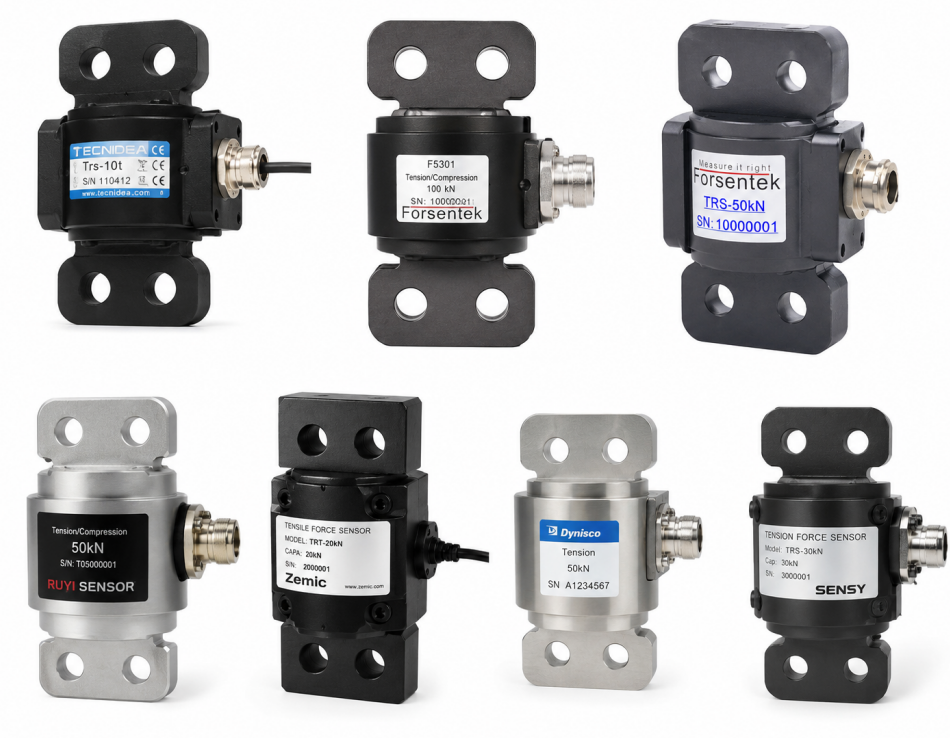
In fields such as engineering vehicles, locomotives, agricultural machinery, and vehicle testing, traction is required.direct measurementThe physical quantity. In this type of scenario, a true "traction force sensor" is used—a force sensor based on the resistance strain effect.
1. Tension/Compression Sensor
Tension sensors are the most commonly used tool for directly measuring traction force. In whole-vehicle traction testing, the vehicle under test is connected to a fixed anchor via a traction cable, and the tension sensor is connected in series in the cable to directly measure the traction force output by the vehicle. This testing method replaces the traditional "load-tow method"—the latter requires two vehicles to travel on the road, which is not only dangerous but also lacks consistency.
In the field of engineering vehicles, there are studies specifically designed...Real-time measurement system for traction force and engine speed of engineering vehiclesReal-time online measurement of traction force is achieved through a high-precision force sensor.In the field of agricultural machinery,Tractor traction resistance sensorTypically installed at the hinge hole of the pull-down rod, it employs a strain gauge measurement scheme, offering advantages in manufacturability and low cost..
The rod-end tension/compression sensor is designed for integration into tension measurement systems, allowing for easy installation in confined spaces, such as alignment with vehicle steering tie rods, and offers a measurement range from 500 to 20,000 pounds of force.These types of sensors are also widely used in automotive durability and reliability testing..
2. Pin-type sensor
In applications such as locomotives and lifting equipment, pin-type sensors (axle pin sensors) are specialized components used to measure traction force or wire rope tension.It can directly replace the original ordinary pin shaft in the equipment and be installed in the structure to measure radial force. In the load monitoring system of equipment such as mine winches, the pin shaft sensor is the core force measuring element, and its size design needs to be based on system analysis of the load characteristics.
3. Wheel force sensor
Wheel force sensorThe Wheel Force Transducer is a more precise traction measurement tool. It is mounted directly on the wheel and measures the forces and torques acting on the wheel during movement. In addition to measuring forces and torques, it can also simultaneously measure wheel speed and position, and is used for braking force measurement.Traction studyAnd tire wear analysis. These sensors can be adapted to the production wheels of any standard vehicle, making them an important tool for vehicle dynamics research.
4. Intelligent tire sensing system
The latest technological advancements areSelf-powered tire sensing systemExamples include TDK's InWheelSense™, which integrates sensing, edge computing, wireless data transmission, and energy harvesting to collect data directly from the tire-road contact surface.The data that can be collected includesWheel/Tire TractionSlip angle, turning angle, tread wear, etc.Thanks to its self-powered design, it can operate continuously without battery replacement, providing real-time data support for fleet management and ADAS systems..
III. Special Measurement Methods for Locomotive Traction Force
In the field of railway locomotives, the measurement method for traction force is even more specialized. Wheel-rail adhesion traction force is a crucial parameter determining the traction performance of electric locomotives, but it cannot be directly detected. In engineering, it is typically measured using…State observerThis method uses detectable quantities (such as traction motor current and speed) as input and obtains a dynamic estimate of the wheel-rail adhesion force through the output of an observer. In addition, tension and compression sensors are also used on locomotive rolling test benches to calculate the circumferential traction force of the locomotive wheels through changes in sensor readings.
IV. Key Points for Selection
The selection of a vehicle traction sensor should be based on the specific application scenario:
- Passenger vehicle TCS systemPay attention to the accuracy (needs to reach ±0.5%) and response speed of the wheel speed sensor, as well as its compatibility with the ECU.
- Whole vehicle traction testChoose a high-precision tension sensor, paying attention to range matching and impact resistance.
- Online monitoring of engineering vehiclesThe sensor's environmental adaptability (waterproof, dustproof, vibration-resistant) and long-term stability need to be considered.
- Locomotive ApplicationsAttention should be paid to the sensor's fatigue resistance and its adaptability to installation space.
V. Development Trends
Vehicle traction sensors are developing in the following directions: FirstlyIntelligentSensors with integrated edge computing capabilities can perform data processing and analysis locally.SecondWireless and self-poweredEnergy harvesting technology frees sensors from battery limitations.ThirdlyMulti-source fusionIt integrates data from multiple sources, including wheel speed, acceleration, and force sensors, to achieve more accurate traction estimation and control; fourthly...High-precision compensationThe nonlinear error and temperature drift of the sensor are compensated by using algorithms such as neural networks.
From indirect calculation to direct measurement, and from single sensor to multi-source fusion, vehicle traction sensor technology is constantly evolving with the development of vehicle intelligence, providing increasingly powerful data support for improving vehicle safety, economy, and intelligence.