



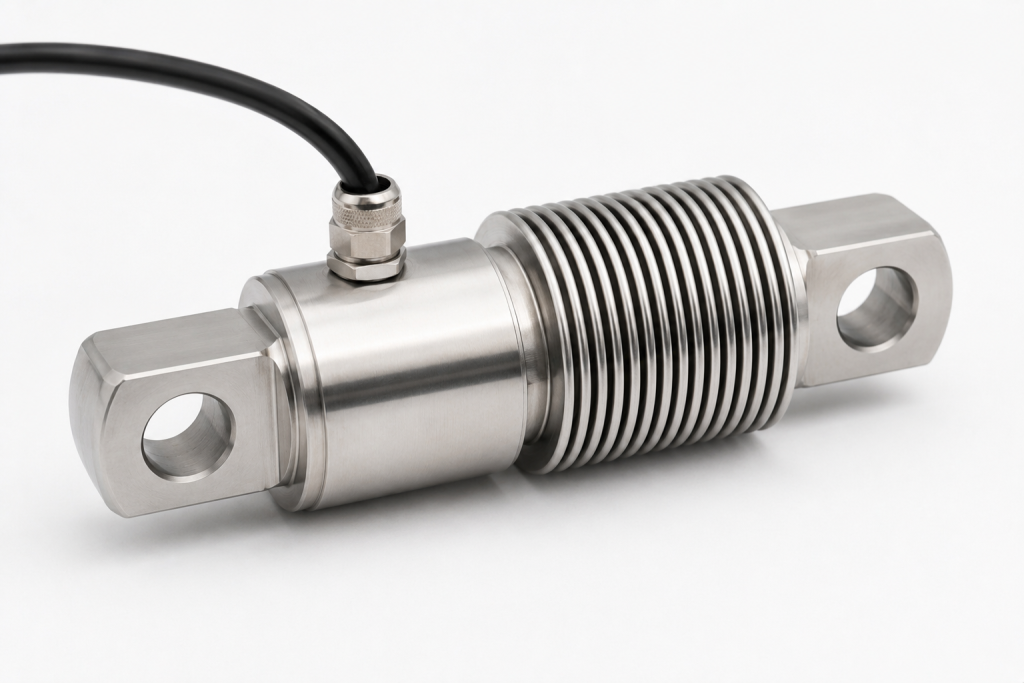
Traction force, a physical quantity long underestimated in agriculture and construction machinery, is undergoing a fundamental revolution in its measurement. For decades, the industry has uniformly relied on a fixed concrete anchor testing system—measuring a peak ultimate tensile force while the equipment is stationary is considered sufficient.The emergence of vehicle-mounted traction sensors is transforming this static, laboratory-based measurement method into a dynamic, real-time, and mobile on-site force measurement solution.
I. The Dilemma of Static Thinking
Traction performance testing has long been a niche area within the force measurement industry. The initial design of the fixed anchor testing system was solely for standardized laboratory testing: fixed site, standardized testing procedures, and a clean and stable environment..
This solution has two inherent, irreparable shortcomings.First, it can only collect the peak value of a single ultimate tensile force when the equipment is stationary.It is completely impossible to reproduce the full dynamic process of actual vehicle operation. The impact load at the moment of start-up, the continuous load fluctuations caused by road bumps, the stable pulling force during constant-speed towing, and the load drop curve during braking—all of this data, crucial for equipment development and fault diagnosis, is missing.Single peak data can only meet basic compliance filing requirements and cannot support equipment power matching optimization, transmission system fault tracing, or comprehensive vehicle performance evaluation..
Secondly, the construction costs of fixed testing sites are high, and their locations are fixed.Actual measurements of agricultural machinery resistance during field operations, temporary towing tests of heavy equipment at construction sites, and performance testing of off-site obstacle clearing vehicles could not be conducted.The large number of real-world testing needs have been unable to be met for a long time, forcing a prolonged equipment development and iteration cycle.
Simply put, for the past few decades, the industry has been using a "static mindset" to measure a "dynamic problem." The emergence of vehicle-mounted traction sensors is bringing force measurement from the laboratory to the fields and construction sites.
II. The Self-Cultivation of a Pole
In a broad sense, a vehicle traction sensor refers to a resistance strain gauge sensor installed in a vehicle's traction system to measure traction force in real time. Its core principle is based on the strain effect: an elastic body undergoes elastic deformation under external force, causing the resistance strain gauge attached to its surface to deform accordingly, resulting in a change in resistance. This change is then converted into an electrical signal output by the measuring circuit.
The mechanical structure of the traction sensor can be determined based on the tractor's traction force and the dimensions of its lower lever hinge hole. Regarding signal processing, since the traction sensor's output signal is weak and accompanied by noise, pre-processing is necessary—using a pre-amplifier circuit and an active low-pass filter can achieve ideal results.
The form of the vehicle-mounted traction sensor varies depending on its installation location. In agriculture, the most common form is a "reinforced tie rod" inserted into the drawbar between the tractor and implements—similar in appearance to a regular tie rod, with pin holes at both ends, which can directly replace a section of the original drawbar.In a tractor's three-point suspension system, a pin-type traction sensor can be installed in the pin hole of the lower rod. In the railway field, a typical form is the coupler tail pin sensor—which directly replaces the tail pin in the original coupler, serving as both a component of the coupler and a traction sensor, without altering the original coupler's mechanical structure.
Regardless of the changes in form, the engineering logic remains highly consistent: intercept a node on the force transmission path so that this node can both perform mechanical functions and output load data.
III. Hard Indicators for Dynamic Force Measurement
The technical specifications of the vehicle-mounted traction sensor reflect its actual capabilities in dynamic force measurement scenarios.
RangeIn terms of traction, standard products cover a range from several tons to tens of tons. A typical model is the WQL-1 traction gauge, with a measurement range of 0 to 20,000 Newtons (approximately 2 tons). In traction testing of a 300-horsepower tractor, the measurement range is required to be no less than 10 tons, with an accuracy of 0.5%.
AccuracyIn terms of measurement accuracy, mainstream products in the industry have a measurement accuracy of 0.5 grade and an indication error of ≤±0.5%. NE's integrated high-precision resistance strain gauge tension sensor has a nonlinearity error of ±0.5%FS.
However, these static parameters cannot fully reflect the capabilities of the vehicle's traction sensor. Dynamic force measurement scenarios place entirely different demands on the sensor.
Sampling frequencyThis is one of the key parameters. In dynamic measurements, insufficient sampling frequency is the primary technical cause of error—when the sampling frequency is less than twice the highest frequency of the measured signal, aliasing occurs, leading to complete distortion of the measurement data. In industry practice, high sampling frequencies are typically around 150Hz, capable of detecting mechanical fluctuations that slower sensors would completely miss. Some portable traction meters can achieve sampling frequencies of up to 1000 times/second, equipped with peak locking functionality, accurately recording the maximum drag force at the moment of vehicle start-up. Zhongke Huigan's products set this indicator at...High-frequency sampling up to 200HzThe continuous change curve of the tensile force throughout the entire process is fully preserved..
Anti-interference capabilityIt's another dimension. Road bumps and equipment vibrations generate a lot of invalid noise, which needs to be intelligently removed through multi-level dynamic anti-interference filtering algorithms.In agricultural machinery traction force testing, the output signal of the tension sensor used is weak and accompanied by noise. The signal must be pre-processed to provide appropriate input to subsequent testing instruments.
IV. Application Scope: From Fields to Mines
The most typical application scenario for vehicle traction sensors isagricultural machinery.
For towed agricultural machinery, measurement is relatively straightforward—simply place a traction sensor or mechanical traction gauge between the tractor and the implements. The traction data output in real time from the sensor is input to the tractor's ECU, allowing the system to adjust engine torque output and limit wheel slippage. In dry, hard soil, resistance increases sharply, while in soft, slippery paddy fields, changes in traction are directly reported.This is particularly noticeable in paddy field operations, where wheel slippage is frequent and traction is insufficient. The system automatically reduces torque to prevent the wheels from spinning idly and burning the friction plates. In dry, hard stubble fields, when resistance reaches a threshold, the system lifts the implement and reduces the depth to maintain reasonable traction..
For suspended agricultural implements, it is necessary to organically combine the three-pin summation circuit and force-measuring pin device with the three-point suspension mechanism to develop a three-point suspension force-measuring device. This device can simultaneously test the component forces in three directions at three suspension points, realizing comprehensive testing of traction force, lifting force, lateral force, and torque.
existConstruction machinery and miningIn the field of vehicle traction sensors, applications are also widespread. In mines and open-pit coal mines, drivers of 100-ton dump trucks have no way of feeling the actual stress on the trailer or the materials in the cargo box.The sensor is mounted on the tow pin or tow hitch, directly measuring the tension between the tractor and trailer. This value is a concrete physical quantity, unaffected by the driver's subjective perception..
Data from a large open-pit coal mine in Inner Mongolia is very convincing: after dozens of mining dump trucks were equipped with vehicle-mounted traction sensors,Loading efficiency improved by about 10%, and tire wear decreased significantly.Drivers no longer rely on guesswork; instead, they use data to shift gears and control the throttle. When traction is too high, they ease off appropriately, reducing tire slippage; when traction is insufficient, they downshift promptly, preventing the engine from stalling..
Practices at some large farms in Northeast China have also shown that after installing traction sensors,Using the same tractor and the same plot of land, fuel consumption can be reduced by several percentage points..
existrailwayIn this field, the coupler traction force monitoring sensor can directly replace the tail pin in the original coupler. The tail pin directly bears the traction force transmitted by the vehicle, and the sensor's force application point can more accurately reflect the magnitude of the coupler traction force, resulting in more accurate measurement data. This sensor can monitor the longitudinal force of the locomotive and the coupler deflection angle of the heavy-haul train in real time.
V. Zhongke Huigan's Engineering Practice
In the area of vehicle-mounted traction sensors, Zhongke Huigan has adopted...Dual-line layoutstrategy.
In product definitionThe product is clearly divided into two application tiers, respectively matching the completely different usage needs of equipment R&D and testing and online safety monitoring of factory equipment. The hardware and software configurations are optimized for these needs, avoiding a one-size-fits-all approach..
At the hardware levelThe elastic matrix uses a thickened, one-piece forged ring structure, specifically designed to enhance its resistance to instantaneous impacts and alternating vibrations.It will not suffer from the problems of frequent zero-point drift and elastic body deformation failure that occur with ordinary tension sensors.Both ends have pre-drilled standard through holes, allowing direct connection to universal shackles, agricultural machinery three-point suspension pins, and trailer towing hooks, eliminating the need for customized non-standard adapters.Its shape is similar to a section of reinforced tie rod, with pin holes at both ends, directly replacing the original traction rod section.The seal is rated IP67, meaning it can withstand mud, fertilizer corrosion, and impacts from gravel..
At the data collection levelEquipped with a self-developed multi-level dynamic anti-interference filtering algorithm, it intelligently removes invalid noise generated by road bumps and equipment vibrations.High-frequency sampling up to 200HzComplete retention tensile force continuous change curve throughout the entire processThis transforms fragmented, single-point static data into complete, analyzable dynamic operating condition data.
At the communication levelThe product line is divided into two configurations: wired transmission and wireless LoRa transmission.The wired version features zero-delay signal transmission and high stability, making it suitable for 24/7 uninterrupted online safety monitoring of trailers and underground transfer equipment within factory areas. It can be configured with a tension threshold to link to a power limiting circuit, automatically cutting off towing power when the load exceeds the limit.The wireless version completely eliminates the constraints of cables, and its transmission distance in open fields and construction sites meets the needs of real-world testing. It can be paired with a portable handheld terminal to visualize load curves in real time..
In terms of market implementationIt covers three non-overlapping application scenarios: field calibration of new tillage implements for agricultural machinery manufacturers, collecting complete traction force data under real soil resistance to optimize engine power output and suspension system matching parameters; mobile on-site annual inspection for motor vehicle comprehensive inspection agencies, not limited by fixed anchor positions; and the installation of wired models on heavy-duty transport trailers in industrial and mining enterprises to monitor towing loads in real time..
In the calibration process, Zhongke Huigan relies on its...1600-ton class hydraulic force standard machineFactory calibrationForce sensors have one key characteristic—inaccurate calibration renders accuracy meaningless. This reference system has a measurement range sufficient to cover the needs of various industrial scenarios, ensuring that each sensor maintains linear accuracy even in harsh industrial environments..
From a broader technological perspective, Zhongke Huigan's early business focused on the traditional weighing and force measurement fields, but in recent years it has gradually expanded into the field of multi-dimensional force sensors.This technological approach is not a replacement for the vehicle's traction sensor, but rather an expansion of force perception capabilities at the system level—moving from load measurement at a single node to comprehensive perception and decision-making through multi-node collaboration.
VI. Conclusion
The value of the vehicle's traction sensor lies in the fact that it transforms the question of "how much force is this vehicle pulling"—a question that could only be answered through experience and estimation—into an engineering parameter that can be measured quantitatively in real time.
It's not some fancy cutting-edge technology—it looks like a rod or a pin, and its working principle is the classic resistance strain gauge force measurement—but it solves a real and common engineering pain point: making traction systems stop "foolishly exerting force."As the industry saying goes, "Machines aren't afraid of hard work, they're afraid of reckless effort; sensors stop that reckless effort.".
From static laboratories with fixed anchors to dynamic real-world applications in fields, from single-peak readings to 200Hz continuous curves, from 0.5% accuracy to IP67 protection rating—behind these numbers lies a cognitive upgrade in "how to measure force." The entry of domestic companies like Zhongke Huigan is transforming this technology from a "standard component in the laboratory" into a "practical tool that can be used with tractors in the wild and in muddy conditions." Less clutch burnout means you've already recouped your investment..