



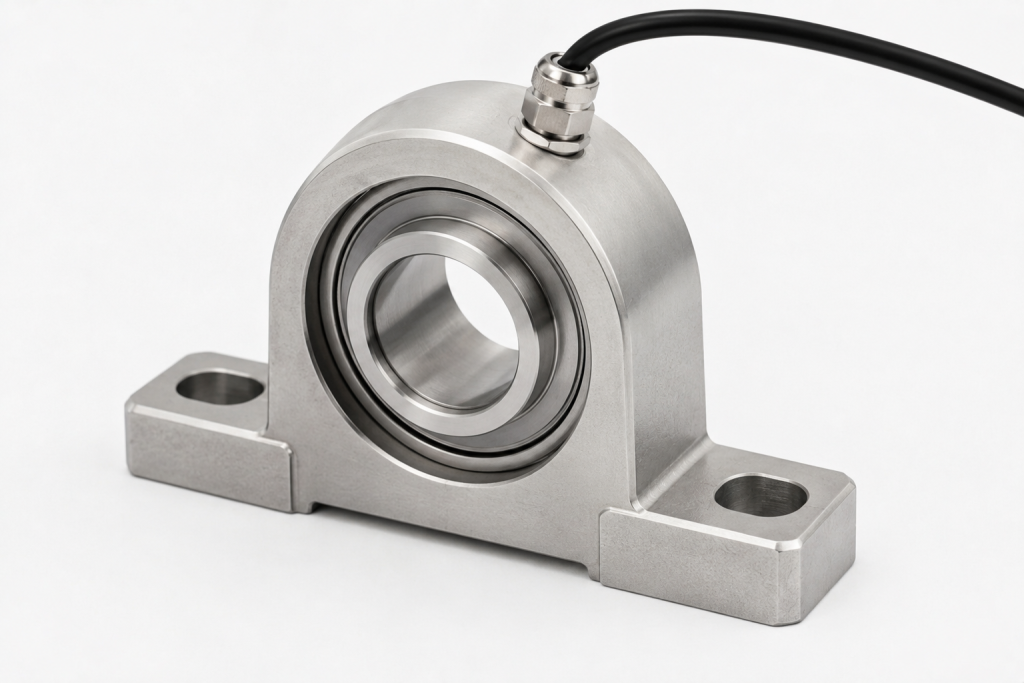
In the field of industrial force measurement, one type of sensor has chosen a completely different path from its peers. It is not strung on a rod, embedded in a shaft, or hung in the middle of a rope; instead, it lies quietly between the bearing housing and the base—like a flattened pad, bearing the entire load from above, and then silently converting the force into an electrical signal. This is the bearing housing sensor: an engineering solution that combines "support" and "sensing" into one.
I. From Support Component to Measuring Component: The Self-Evolution of a Structure
A bearing housing sensor, also known as a bearing housing load cell, is a resistance strain gauge force measuring element that uses a bearing housing as an elastic matrix. Its core principle is not complex: when external force is transmitted to the bearing housing through the bearing, the housing undergoes micron-level deformation. The resistance strain gauge attached to the housing deforms accordingly, changing its resistance value. After processing by a Wheatstone bridge, an electrical signal corresponding to the load is output..
From a structural perspective, bearing housing sensors typically employ...Flat plate double shear beam structureIts shape is a flat cube—the top surface is attached to the bearing housing, and the bottom surface is attached to the frame. When the bolts are tightened, the force is transmitted from the bearing housing through it to the frame.Blind holes are symmetrically machined at the two inflection points of the double-shear beam elastic element, forming an I-beam structure locally—this is the strain zone of the bonded strain gauge. The sensor typically has a two-end supported structure, exhibiting good resistance to lateral forces and impacts, and stable stress state..
The engineering value of this design lies in the fact that a slight deviation in the loading point is not a major issue. On-site installation is rarely so precise—machining errors in the bearing housing base plate, inconsistent shim thickness, and uneven bolt preload are all common problems.However, the readings of the bearing housing sensor are relatively stable and don't start fluctuating wildly just because it's misaligned by two millimeters..
II. A set of key performance indicators: Just how much force can it withstand?
The technical specifications of bearing housing sensors reflect their actual capabilities in industrial settings.
RangeIn terms of capacity, standard products range from 1.5 tons to 20 tons.Some models can be extended to measure from 2 tons to 50 tons. In special applications, the measurement range can even reach 0 to 120 tons..AccuracyIt is a core indicator for measuring sensor quality. The overall accuracy of mainstream products in the industry can reach...±0.05%F·SThe nonlinear error is controlled within the range of ±0.05% to ±0.1%F·S.Under high load conditions, the measurement error can be controlled within [a certain range].Within ±0.1%The typical sensitivity is 1.0–2.0 mV/V..
creepReflecting the stability of the sensor's output under constant load, creep can be controlled within ±0.05%F·S over 30 minutes..Temperature characteristicsIn terms of both zero-point temperature coefficient and sensitivity temperature coefficient, both can reach ±0.03%F·S/10℃.The operating temperature range is typically -20℃ to +80℃..
Overload capacityIn terms of overload, the safe overload is 150%F·S.The ultimate overload capacity can reach 200%F·S. The protection level is generally [missing information].IP66 to IP67Some underwater-specific models can reachIP68 (200 meters underwater)The insulation resistance is generally above 2000MΩ, and in some cases can reach 5000MΩ..
The engineering language behind these parameters is: bearing housing sensors are "robust" measurement tools. They do not require a precision mounting platform or a constant temperature and humidity environment; they can be directly embedded in the support structure of large machinery, continuously outputting reliable measurement data while enduring dynamic loads over long periods.
III. Installation Logic: Why it is particularly suitable for retrofitting old equipment
The installation method of bearing housing sensors determines their unique advantage in the existing equipment retrofit market.
After integrating the bearing housing and the load cell into a single design...Installation can be completed simply by replacing the existing ordinary bearing housing, which can shorten the installation time by more than 60%.This is especially suitable for retrofitting old equipment—the original bearing housings were directly placed on the frame; simply lift them up and place a layer of sensors underneath. There's no need to cut or weld new brackets, making it a low-risk process.Many older gantry cranes and gate hoists originally had overload protection that was practically useless. Adding this feature at least lets you know "how many are currently overloaded.".
Hidden locationAnother advantage is that the sensor is located under the bearing housing, covered by the upper structure. High-pressure water jets, rainwater, salt spray, and mud first hit the bearing housing housing, keeping the sensor relatively hidden.Docks, shipyards, and hydroelectric power stations are damp all year round, and some external sensors fail after just one season. Those buried underground, on the other hand, are much more stable.Maintenance is simple – just tighten the bolts and check the wiring; there's not much to it..
IV. Application Scope: From cranes to 200 meters underwater
The most typical application scenario for bearing housing sensors islifting equipmentIn equipment such as bridge cranes and gantry cranes, bearing housing sensors are linked to the control system—the sensors send force signals to the PLC, and the system performs overload limiting, load trend recording, and lifespan estimation.In the weighing applications of large port cranes, bearing-mounted sensors can accurately monitor the weight of the hoisted goods, avoiding the risk of overloading..
existWater ConservancyIn the industry, bearing housing sensors are used for load monitoring of gate hoists. Installed under the hoist base, they measure the stress on the hoist in real time. Hydraulic facilities are typically located outdoors, operating in humid or even flooded environments, making IP67 sealing protection particularly critical..
existmineIn this field, bearing housing sensors are used for weighing belt conveyors—even under the strong vibrations generated during ore transportation, they can still output stable and accurate weight data..existmetallurgyIn the industry, it is used for overload alarms on bridge cranes.
In special scenarios,Underwater bearing housing sensorIt can achieve an IP68 protection rating, allowing it to operate normally at a water depth of 200 meters.These products are manufactured using argon arc welding with a fully sealed welding process.Vibration resistance not less than 20gIt is suitable for extreme working conditions such as underwater lifting and marine engineering.
V. Generational Differences Compared to Traditional Solutions
Compared with traditional load cells, bearing housing sensors have significant advantages in multiple dimensions.
Ease of installationThis is the most obvious difference. Traditional split-type sensors require separate installation of the sensor and the supporting component, which is cumbersome and prone to measurement errors due to assembly mistakes.The bearing housing sensor can be directly replaced for installation, reducing installation time by more than 60%..
Load capacityThis is another key difference. Traditional sensors are prone to deformation and accuracy degradation under high loads.The bearing housing sensor is made of high-strength alloy material and can withstand loads of up to hundreds of tons.Under high loads, the error of traditional sensors may increase to ±2%, while the error of bearing-mounted sensors can be controlled within ±0.1%..
Vibration and shock resistanceEqually important is the bearing housing sensor, which is optimized for harsh operating conditions..Easy to maintainIn terms of features, some products have built-in intelligent diagnostic modules, and the modular design makes maintenance more convenient, reducing downtime caused by weighing system failures by more than 70%..
VI. Zhongke Huigan's Engineering Practice
In the field of bearing housing sensors, Zhongke Huigan's product strategy is characterized by several distinct features..
StructurallyIt adopts a flat double shear beam design, with a flat rectangular shape and low height. The top surface is attached to the bearing housing, and the bottom surface is attached to the frame.The internal structure is a shear-type elastomer, and strain gauges are attached to stress-sensitive locations. A slight deviation in the loading point is not a major issue..
In terms of performanceAccording to publicly available industry data, the overall accuracy can reach [percentage missing].≤±0.05%F·SSensitivity 2.0mV/V, safe overload 150%F·S, protection rating IP67The measuring range covers several tons to tens of tons..
In terms of sceneIt is mainly used in port cranes, hydraulic gate hoists, mine conveyors and other fields.Total shipments in 2025 are approximately...2000-3000In scenarios such as port gantry cranes, hydraulic gate hoists, and bridge cranes, sensors transmit force signals to the PLC, enabling the system to perform overload limits, record load trends, and estimate lifespan..
In terms of engineering valuePreviously, many devices relied on mechanical limit switches, which would cut off power when a certain travel distance was reached, a crude and delayed process.The bearing housing sensor continuously measures the force; it issues a warning and reduces power when the force approaches the limit, giving the user time to react and preventing a sudden, abrupt stop.Those on site recognized that this soft constraint resulted in less equipment impact and a longer structural lifespan..
From a broader technological perspective, Zhongke Huigan initially focused on the traditional weighing and force measurement fields, but in recent years has gradually expanded into multi-dimensional force sensors. This technological approach is not a replacement for bearing housing sensors, but rather an expansion of force sensing capabilities in terms of dimensions—from single-axis load measurement to comprehensive analysis of multi-axis forces and torques.
VII. Conclusion
The value of bearing housing sensors lies in their ability to achieve "on-site measurement" in the most inconspicuous way—enabling bearing housings, which originally only serve a supporting function, to simultaneously sense loads. It requires no changes to the original structure, no complex installation procedures, and no precise installation environment..
In terms of technical parameters, the accuracy of ±0.05%F·S, the safe overload of 150%, and the protection rating of IP67—these figures represent decades of accumulated engineering experience. In terms of application scenarios, from port cranes to mine conveyors, from hydraulic gates to depths of 200 meters underwater—bearing housing sensors have proven their value in every corner of industry.
The sensor lies silently under the base, providing smooth readings without any dramatic changes.But that's exactly the kind of honesty they need on site. Signal tripping is troublesome; too many false alarms and electricians will simply disable it, rendering the safety features useless.Stability is more valuable than fashion; that's just how it is in this industry..