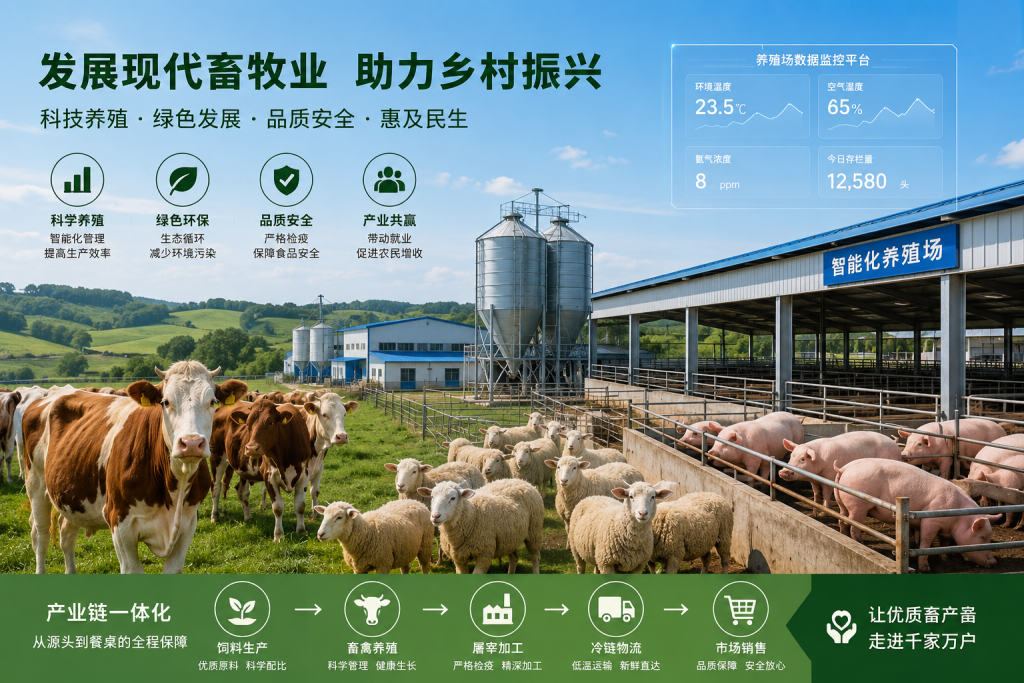



In today's world, where the digital wave is sweeping the globe, intelligentization is no longer a label exclusive to the industrial or internet sectors. The livestock industry, a traditional industry spanning thousands of years, is undergoing an unprecedented technological revolution. From "relying on experience" to "relying on data," from "extensive" to "intensive," the trend of intelligentization is profoundly reshaping every aspect of the livestock industry. So, where is this transformation headed? This article will provide an in-depth analysis.
Precision farming: From "human observation" to "data-driven diagnosis"
In traditional animal husbandry, assessing livestock health often relies on the farmer's experience and intuition—a quick glance at their demeanor, a touch of their body temperature, and a check of their feed intake. However, this method is not only highly subjective but also lacks real-time accuracy and comprehensiveness. The advent of intelligent technology has completely changed this situation.
Today, by wearing smart ear tags, collars, or implanted sensors, farmers can obtain real-time data on key physiological indicators for each animal, such as body temperature, heart rate, activity level, and rumination frequency. The data is wirelessly transmitted to a central platform, where algorithms automatically analyze the individual animal's health status. If any indicator deviates from the normal range, the system immediately issues a warning via a mobile app or management backend, indicating potential disease risks or signs of estrus.
Data supports this: According to statistics from the Ministry of Agriculture and Rural Affairs' smart livestock farming pilot project, after adopting precision monitoring technology, the average morbidity and mortality rates of livestock decreased by more than 301 TP3T, and the early detection time of diseases was advanced by an average of 12-24 hours, significantly reducing medication costs and economic losses. It can be figuratively said that each animal now has a "personal doctor," online 24 hours a day, never neglecting their duties.
Intelligent feeding: Meals are prepared on demand, with precision down to the gram.
Traditional artificial feeding is not only labor-intensive, but also makes it difficult to "feed according to the pigs" or "quantify according to the cattle". The mass feeding method often results in strong pigs eating too much and weak pigs not eating enough, leading to low feed utilization and poor nutritional balance.
The emergence of intelligent feeding systems has completely solved this pain point. These systems typically integrate weighing sensors, RFID readers, automatic feeding devices, and intelligent control software. When livestock approach the feeding trough, the system automatically identifies them and, based on their weight, age, growth stage, pregnancy status (for sows), and even historical feeding data, calculates the required nutrient ratio for the day in real time, dispensing feed precisely. Simultaneously, the system can adjust the feeding rhythm according to the feeding speed, avoiding waste.
Benefit Analysis: A comparative experiment conducted by the College of Animal Science and Technology at China Agricultural University showed that after applying the intelligent feeding system, feed conversion ratio increased by 81-121 TP3T, feed costs decreased by 15-201 TP3T, and the fattening cycle was shortened by approximately 7-10 days. Taking a pig farm with 1,000 head as an example, tens of thousands to hundreds of thousands of yuan can be saved annually on feed alone. Farmers only need to view the feed intake reports of each animal on their mobile phones and remotely adjust the feeding plan—truly realizing "farming at your fingertips."
Intelligent environmental monitoring: Creating a "five-star habitat" for livestock.
Temperature, humidity, ammonia concentration, carbon dioxide levels, light intensity… these environmental factors directly affect livestock feed intake, growth rate, and immunity. Traditional farms often rely on regular inspections and manual adjustments, resulting in delayed responses and significant environmental fluctuations. Especially during extreme winter and summer weather conditions, even slight negligence can trigger mass stress reactions or respiratory diseases.
The intelligent environmental monitoring system collects and uploads environmental data in real time by deploying various types of sensors within the enclosures. When any indicator exceeds a set threshold, the system automatically activates and adjusts equipment such as fans, evaporative cooling pads, heaters, and ammonia purification devices, and records the event. Advanced systems can even pre-adjust based on weather forecasts, such as starting ventilation and cooling in advance before high temperatures arrive.
Empirical Results: According to a survey by the European Society of Livestock Engineering, stable intelligent environmental control can increase the daily weight gain of pigs by 101 TP3T-151 TP3T, increase milk production in dairy cows by 81 TP3T-121 TP3T, and increase egg production in laying hens by 51 TP3T-81 TP3T. Simultaneously, the incidence of respiratory diseases decreases by approximately 251 TP3T. In short, the intelligent environmental system creates a five-star living environment for livestock—constant temperature, constant humidity, fresh air, and quiet—making them comfortable, naturally leading to faster growth and higher egg production.
Big Data and Artificial Intelligence: From Looking Back to Looking Forward
If sensing and execution devices are the "hands and feet" and "sensors" of intelligent farming, then big data and artificial intelligence are its "brain" and "nerve center." As farm data accumulates and becomes increasingly abundant, data analysis is beginning to play a truly strategic role.
Market Forecasting and Production Planning: By integrating historical price data, regional inventory levels, feed costs, and holiday consumption fluctuations, AI models can predict market conditions for the next 3-6 months, assisting farmers in deciding when to replenish their stock, when to sell, and how to adjust the breeding pig ratio. A 10,000-head pig farm in Shandong province, after adopting the AI forecasting system, accurately avoided two pig cycle troughs, increasing its annual profit by nearly 301 million pigs per 3 tons.
Disease Early Warning and Intelligent Diagnosis: A machine learning-based disease early warning system can comprehensively analyze morbidity rates, meteorological data, and biosecurity incidents from multiple farms in a region, providing early warnings of epidemic risks 7-14 days in advance. When suspected sick animals appear, farmers only need to upload photos of symptoms or videos of behavior, and the AI-assisted diagnostic system can provide preliminary judgments and treatment suggestions, greatly shortening the time from discovery to intervention.
Genetic breeding optimization: By combining genomic selection technology and growth data modeling, AI can quickly screen for optimal breeding stock combinations, accelerating genetic progress. A large pig breeding company, after applying an AI breeding platform, saw a genetic progress increase of over 20% per generation.
Expert Opinion: Liu Qiang, Secretary-General of the Intelligent Livestock Branch of the China Animal Husbandry Association, pointed out: "In the next three to five years, data-driven decision-making will become the core competitiveness of livestock enterprises. Livestock farmers who don't use data are like navigators without a compass, finding it difficult to go far in the fierce market competition." Statistics show that livestock enterprises that were among the first to apply big data and AI decision-making saw an average increase in the accuracy of their production decisions of 201-251 times, and a significant reduction in operational risks.
Looking to the future: unmanned, end-to-end, and ecosystem-based.
Intelligentization is not the end, but a continuous evolutionary journey. Looking ahead, the intelligentization of the livestock industry will exhibit three major trends:
First, unmanned farming is gradually becoming more widespread. From automated feeding, automated manure removal, and automated inspection robots to machine vision-based weight estimation and behavior analysis, more and more processes will see machines replacing human labor. Some leading farming companies have already built "lights-out pig farms"—farms that can still operate normally even when the lights are off.
Second, end-to-end data connectivity. Future intelligent farming systems will no longer be confined to the farm itself, but will connect upstream to feed and seedling suppliers, and downstream to slaughterhouses, logistics, and retail outlets, forming a fully traceable data chain from "farm to table." Consumers can scan the QR code on meat packaging to see the animal's growth trajectory, health records, and inspection reports—significantly reducing trust costs.
Third, ecological and intelligent decision-making. The AI system will integrate more multi-dimensional external data, such as meteorological disaster warnings, regional dynamics of diseases, and changes in international trade policies, to provide farmers with comprehensive risk warnings and business advice. Farming is no longer an isolated physical activity, but a smart industry that integrates agriculture, information technology, finance, meteorology, and other disciplines.
Conclusion: Embrace intelligence, win the future
Intelligentization in the livestock industry is not an option, but a necessity. It brings not only increased production efficiency and reduced costs, but also a profound restructuring of the entire industry's production models, management philosophies, and business logic. From precise sensing to intelligent decision-making, from individual equipment to system integration, from human experience to data-driven approaches—intelligentization is giving traditional livestock farming a completely new lease on life.
For most farmers, there's no need to be intimidated by the term "high-tech." The path to intelligent management can be gradual: start with an intelligent environmental control system, then introduce intelligent feeding, and gradually build a data platform. The key is to take the first step and continuously learn and iterate.
The wave of technology has arrived, and the future of the livestock industry will undoubtedly be more efficient, greener, and more sustainable thanks to intelligence. Are you ready?