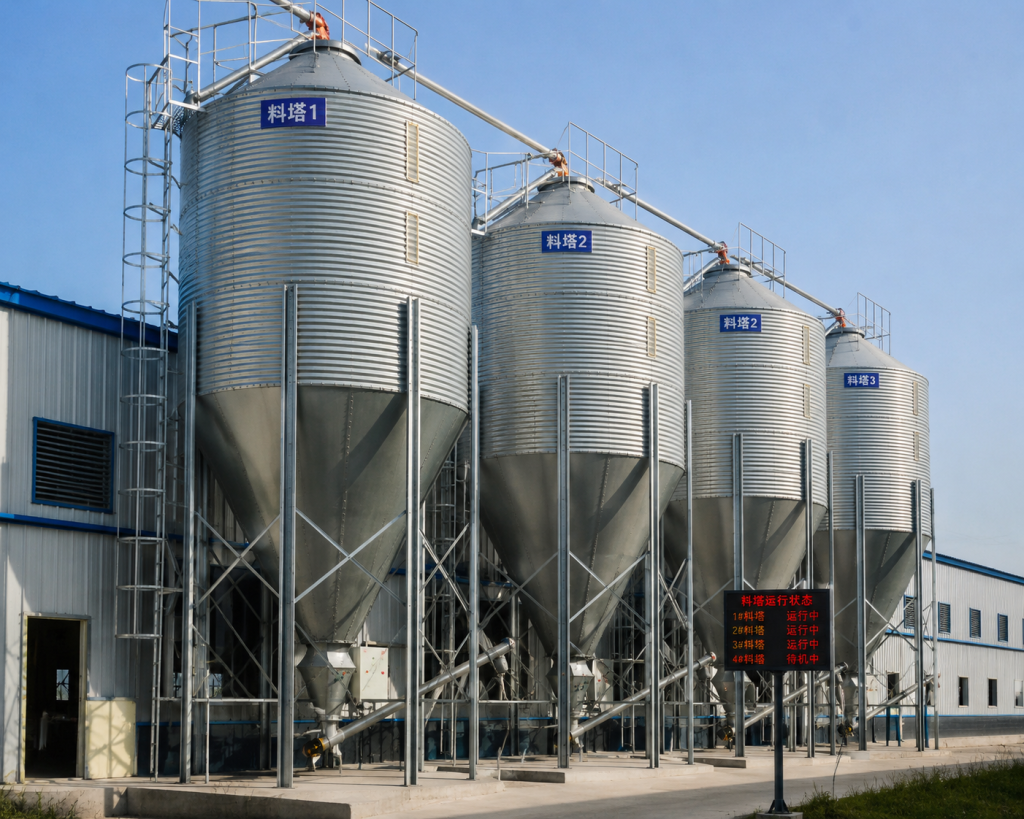



In daily farming management, feed towers frequently undergo emptying and reloading processes, sometimes empty and sometimes full. This repeated change in load has led many farmers to have a common question: Will such frequent load switching "damage" the weighing equipment and cause its accuracy to gradually decrease? This is actually a common misconception about the equipment in the industry.
Indeed, for ordinary civilian weighing equipment, frequent switching between heavy load and no load can easily cause fatigue damage to elastic components, leading to a decrease in accuracy. However, industrial-grade pylon weighing modules are designed to cope with long-term dynamic load-bearing working scenarios. These devices are specifically adapted to the repeated loading, discharging, and emptying of pylons, and can operate stably in environments with high-frequency load changes.
In the daily operation of a weighing tower, full load, empty load with zeroing, and half load operation are all normal states. High-quality industrial weighing core components are usually made of highly elastic and tough alloy materials, possessing excellent compressive and fatigue resistance, and can withstand tens of thousands of load switching cycles without deformation or accuracy degradation. In other words, normal empty-full alternation is far from enough to cause substantial damage to the equipment.
So, what truly affects equipment accuracy? Experience shows that the root of the problem is never normal load alternation, but rather abnormal stress and lack of maintenance that many farms easily overlook. For example:
During tower cleaning or maintenance, manual forceful prying of the tower body or stepping on the support legs may cause the force direction of the weighing module to shift.
The equipment has been accumulating dust and water for a long time without being cleaned in time, which has caused corrosion of components or poor electrical connections;
Uneven settlement of the foundation causes an imbalance of forces at each support point, which in turn leads to systematic measurement errors.
In addition, improper operation during the feeding process should not be ignored. In some farms, vehicles collide with the feed tower at close range during feeding, or materials are poured in a concentrated manner, causing a violent impact on the tower body. This instantaneous impact force often far exceeds the normal load-bearing capacity of the equipment. Over time, this can cause minute deformations of the elastic element inside the sensor, gradually manifesting as data drift or decreased repeatability.
To ensure long-term stable accuracy of the equipment, farmers do not need to worry excessively about normal switching between no-load and full-load conditions. They only need to perform the following basic protection and standardized operations:
1. Reduce feeding impact: Control the material pouring speed during feeding to avoid large drops and concentrated impacts. Buffer devices or guide plates can be installed.
2. Keep equipment clean: Regularly clean dust, water, and debris from the equipment surface to prevent corrosive substances from damaging it;
3. Annual inspection and calibration: The system shall be overhauled at least once a year, the outriggers shall be leveled, the force on each sensor shall be checked for balance, and on-site calibration shall be performed if necessary.
4. Standardize work practices: Do not apply excessive external force to the tower body or outriggers during emptying or maintenance to avoid abnormal stress caused by human error.
In summary, standard industrial-grade feed tower weighing equipment is designed to handle the frequent dynamic loads on feed towers in livestock farms. Under normal and standardized use, supplemented by regular simple maintenance, the equipment can maintain high-precision operation year-round, unaffected by daily switching between no-load and full-load conditions, providing stable and reliable metering data for livestock farms in the long term, thus contributing to refined management and cost control.