



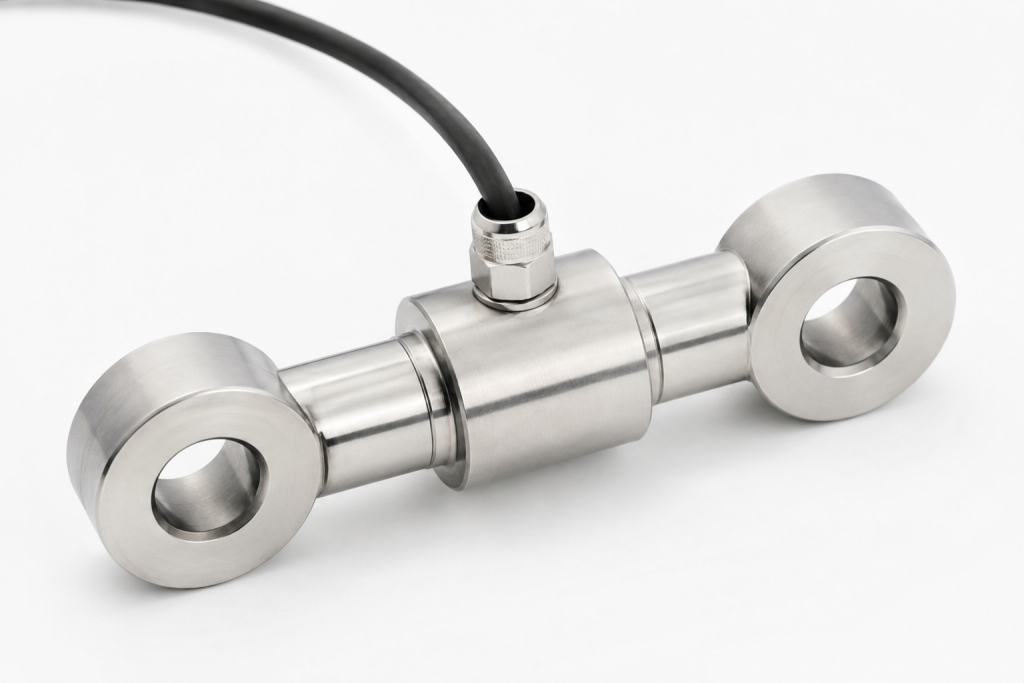
In industrial settings, the pin is a component with a very low profile—pulleys rotate because of it, hooks connect because of it, and connecting rods hinge because of it. It silently bears shear forces without ever making a sound. But there is a type of sensor that gives this pin, which originally only "transmits force," the mission of "measuring force." It does not change the shape of the mechanical structure, nor does it add extra installation space; it simply transforms an ordinary pin into a precision force measuring instrument. This logic of "in-situ measurement" is most thoroughly implemented in the pin sensor.
I. From "Force Transmission" to "Force Measurement": The Self-Transformation of a Shaft
The technological origins of pivot pin sensors can be traced back to a design shift in the field of electronic weighing instruments in the 1990s. At that time, the overall design of some electronic weighing instruments began to move away from the traditional component assembly structure, and the load-bearing structure and load cell began to be integrated into one unit.The axle pin sensors used in electronic crane scales and overhead crane scales are a typical example of this approach..
A shaft pin sensor is essentially a hollow circular shaft that withstands shear forces.The double-shear resistance strain gauge is precisely mounted at the center of the groove inside the central hole—the area of greatest shear stress.When external force is transmitted through the shaft pin, the shaft pin body undergoes shear deformation. The strain gauge converts this micron-level mechanical deformation into a change in resistance, which is then converted into a measurable electrical signal output via a Wheatstone bridge.There are two bridge configuration methods: either the strain gauges at the two grooves together form a Wheatstone bridge, or they are configured separately as bridges and then connected in parallel for measurement..
From its appearance, it's just a shaft—almost indistinguishable from the ordinary pin it replaced. But it's precisely this "indistinguishable" design that highlights the core value of the shaft pin sensor:Without altering the basic form of the mechanical structure, new capabilities are given to structural components..
II. Engineering Wisdom of Hollow Sections
The structural design of the shaft pin sensor revolves around a core challenge: how to conceal the sensitive element within a limited space while ensuring the shaft is robust enough. The solution is a "hollow cross-section circular shaft".
The elastic element is a single hollow circular shaft, which has a compact structure, simple geometry, and is easy to machine with high dimensional and positional accuracy.The hollow section design offers several advantages. First, it possesses strong resistance to torsion and bending.Secondly, the stress is greatest at the neutral shaft of the pivot pin—which happens to be the ideal mounting location for the strain gauge.Third, when designing larger capacity shaft pin sensors, the center hole is correspondingly enlarged, allowing the strain gauge to be easily mounted inside the hole. This provides both physical protection and allows for a vacuum-sealing process using inert gas.Typical products offer protection ratings from IP66 to IP67, with some high-end models even reaching IP69K..
Assembly with the relevant load-bearing components is also relatively easy—installation can be completed simply by replacing the original pins.This "non-invasive replacement" characteristic makes the shaft pin sensor suitable not only for new equipment design but also for the intelligent transformation of existing equipment.
However, structural simplicity does not equate to ease of manufacturing. The manufacturing difficulty of the pin-type sensor stems precisely from its "simplicity"—the strain gauge needs to be bonded to the inner wall of a deep hole, requiring manufacturers to purchase and design specialized sandblasting, scribing, and pressure curing tools and equipment.This is a completely different process system from conventional strain gauge bonding—the operating space is limited, visibility is poor, but the precision requirements are no less stringent.
The calibration process is even more crucial. Since the pivot sensor itself is a single, integral elastic element, lacking a protective housing, loading head, and bearing base, testing and calibration must employ the same boundary support conditions as the actual installation and use; ideally, the same support should be used.Otherwise, the calibration data will lose its practical meaning.This means that the accuracy of the pivot sensor depends not only on the design itself, but also on a deep understanding of the actual working conditions and precise matching of calibration conditions.
III. Hard Indicators: The Engineering Meaning of a Set of Data
The technical specifications of the pivot pin sensor reflect its actual capability limits in the field of industrial force measurement.
RangeIn terms of volume, conventional products range from 0.5 tons to 100 tons..AccuracyIn terms of overall accuracy, the mainstream products in the industry range from 0.51 TP3 TFS to 11 TP3 TFS.High-end products can reach 0.11 TP3 TFS.creep(30 minutes) can be controlled within ±0.05%FS.
Environmental adaptabilityIn terms of operating temperature, the typical range is -18℃ to 65℃.Some products can be extended to -40℃ to 85℃.Protection levels can reach IP66, IP67, or even IP69K..Safety overloadThe capacity is typically 150% of the rated load.The fracture load of some products can reach more than 300%.
What do these parameters mean? Simply put, a pivot pin sensor is a "robust" measuring tool—it does not require a precision mounting platform or a constant temperature and humidity environment, and can be directly embedded in the structure of large machinery, continuously outputting reliable measurement data while enduring dynamic loads over a long period of time.
IV. Application Layout: From Hook to Gate
The most typical application scenario for pivot pin sensors isLifting equipment and hoisting machineryIt can replace the shaft of a balance pulley or a fixed pulley, and be installed in components such as hooks and pulley blocks.In the field of electronic crane scales, the most common type is the combination of a pivot sensor and a U-shaped lifting ring to assemble a digital display or wireless transmission electronic crane scale.Because the axle pin is directly assembled with the lifting eye and hook, it not only eliminates the need for a complex load-bearing shell but also improves assembly accuracy..
More broadly, the application of pivot pin sensors has extended to...Port and wharf metering, safety inspection of gate hoists and lifting equipment, fifth-wheel force measurement in the automotive industry, mining vehicles, and construction hoists.fields.existCivil Engineering and Structural TestingIn this context, it is used to measure the radial load on components such as bearings and pulleys, or the tension of wire ropes..existagricultureIn this field, pivot pin sensors are used for real-time measurement of the ground pressure of seedlings.railwayIn this field, it can directly replace the tail pin in the original coupler and monitor the coupler force in real time.
existWater ConservancyIn the industry, the application of pivot pin sensors is rapidly expanding. During the opening and closing of gates, multiple uncertain loads such as water flow impact, siltation, and water level pressure difference act continuously. Traditional gate hoists rely solely on motor current and mechanical limit switches to determine the load status, resulting in significant errors.In the first half of 2026, Zhongke Huigan alone shipped over 750 sets of hydraulic-specific shaft pin sensors.This sensor uses an in-situ replacement solution, directly replacing the original hinge pin of the gate hoist without modifying the equipment frame or damaging the civil engineering structure.The product boasts an IP67 protection rating, operates stably across a wide temperature range of -40℃ to 85℃, and has a comprehensive accuracy of 0.3%FS, enabling it to capture dynamic load changes throughout the entire gate lifting and lowering process..
Depending on the application, the pin sensor can be installed at the joint of two metal structures.Hooks, rigging shackles, movable pulleys (blocks), fixed pulleys (blocks), wedge joints, cable jointsIt can replace the function of the original shaft and also serve as a weighing and force sensor, greatly simplifying the mechanical components of the entire force measurement and control system.
V. Technological Evolution: From Unidirectional to Multidimensional
Traditional shaft pin sensors mainly measureOne directionThe force is unidirectional. However, in actual mechanical structures, the force on a pin is often multidirectional and variable. When faced with working conditions where the direction of force changes, a unidirectional stress pin cannot accurately detect the direction of the force and the magnitude of the load.
This limitation gave rise toTwo-way or even three-way force-measuring pin sensorsThe emergence of bidirectional force-measuring pins allows for the measurement of forces along both the X and Y axes in the radial direction, enabling the calculation of the actual force direction and magnitude. Tridirectional force sensors, on the other hand, achieve precise measurement of radial and axial forces by incorporating grouped strain gauges on the pin's elastic element, combined with a Wheatstone bridge circuit and axial prestressing assembly technology. This evolution from unidirectional to multidirectional pin sensors clearly demonstrates that industrial automation demands higher information dimensions from sensors.
VI. Zhongke Huigan's Technical Roadmap
In the field of pin sensors, Zhongke Huigan's product strategy is characterized by several distinct features.
In an integrated structureThe Zhongke Huigan SM23C shaft pin sensor adopts an innovative integrated shaft pin structure, seamlessly integrating the sensor core with the shaft pin body.No additional equipment modifications are required; installation can be completed simply by replacing traditional shaft pins. The external dimensions are strictly designed according to ISO standard mechanical shaft systems, requiring no modification to the connecting plate, no re-boring, and no shims.The SM23C series covers a range from several hundred kilograms to 20 tons and even higher, customized options..Measurement accuracy reaches 0.1%FSForce ranges are available from 0 to 50 kN to 0 to 5000 kN.With an overload capacity of 150%FS, it can maintain stable output even after undergoing tens of millions of cyclic load tests..
In terms of environmental adaptabilityFeaturing a fully sealed stainless steel housing with an IP67 protection rating, it can operate stably in a wide temperature range of -40℃ to 85℃ and in high humidity environments with no condensation (0~95℃).The product surface undergoes a special anti-corrosion treatment, enabling it to resist salt spray corrosion from marine climates and dust erosion from mining environments..
In-depth exploration of scenariosZhongke Huigan has made specific optimizations for scenarios such as ports and water conservancy. In the first half of 2026, its water conservancy-specific shaft pin sensors shipped more than 750 sets.Designed for the unique working conditions of water conservancy sites, including prolonged periods of humidity and dust, long periods of equipment idle time, and significant day-night temperature differences, the product employs a vacuum nitrogen-filled fully sealed process and incorporates global adaptive temperature compensation technology.It supports RS485 and 4-20mA dual signal output, and can be directly connected to the smart water conservancy management and control platform and local industrial control system..
From a broader technological perspective, Zhongke Huigan initially focused on the traditional weighing and force measurement fields, but in recent years has gradually expanded into multi-dimensional force sensors. This technological approach is not a replacement for pin-type sensors, but rather an expansion of force sensing capabilities in terms of dimensions—from single-axis shear force measurement to comprehensive analysis of multi-axis forces and torques.
VII. Conclusion
The value of the shaft pin sensor lies in its ability to unify load-bearing and sensing in the most "unassuming" way. From the outside, it's just a shaft; but inside, it contains strain gauges, bridges, and sealed chambers. It doesn't change the basic form of the mechanical structure, but it gives this shaft a completely new capability—allowing the device to know "how much force it is bearing."
Since the integrated design of electronic crane scales in the 1990s, the development of axle pin sensors has gone through more than 30 years.While not the most cutting-edge technology, it continues to play an irreplaceable role in numerous fields such as lifting, ports, water conservancy, metallurgy, and agriculture. The pin-type sensor embodies the development trend of miniaturization, modularization, integration, and intelligence in electronic weighing instruments..
Meanwhile, the entire force sensing technology field is evolving towards higher dimensions. From single-point force measurement to multi-dimensional force sensing, from passive measurement to intelligent analysis, the pace of technological iteration is accelerating. The "structure as sensor" design concept represented by the pin sensor, together with the multi-dimensional force sensing technology being explored by companies like Zhongke Huigan, constitutes a complete picture of the industrial force measurement field moving from "measurement" to "sensing"—the former representing reliable engineering practice, and the latter representing an advanced technological direction. The tension and complementarity between the two are precisely the intrinsic driving force for the continuous evolution of this field.